
Most Americans have a tendency to view the population of Mexico as a somewhat homogenous mix of Spaniards and the indigenous peoples – primarily Aztec and Mayan. There is, however, a large segment of the Mexican population is descended from the slave population of the early colonial period.
An estimated two hundred thousand enslaved Africans were brought directly to New Spain, largely through the port of Veracruz. Many more migrated from neighboring Caribbean and Central American colonies, and from the American Deep South. By the time of Mexican independence in the first Mexican revolution in 1821, about 10% of the population was of African descent, many of whom played key roles in the decade long fight for independence. The early leader of the revolution and second President Vicente Guerrero was born in the mountains north of Acapulco and was likely of Afro-Mexican heritage.
Mexico abolished slavery in 1829, largely at Guerrero’s insistence, and became a welcoming location for escaping slaves from adjacent countries. At the same time, the nationalist movement was based on the notion that Mexico possessed a unique cultural tradition resulting from the intermixing of the indigenous and Spanish populations. The Afro-Mexican population, despite its importance, faded into the background.
It wasn’t until 2015 that Mexico first provided an estimate of the Afro-Mexican population, which is currently estimated at 2.4% of the population. While a large share of the original Afro-Mexican population was assimilated over the decades, there are several areas of the country where the population has remained relatively distinct.
The map below uses a generalization based on the H3 level 6 hexagons in order to smooth out the surface for interpretation.
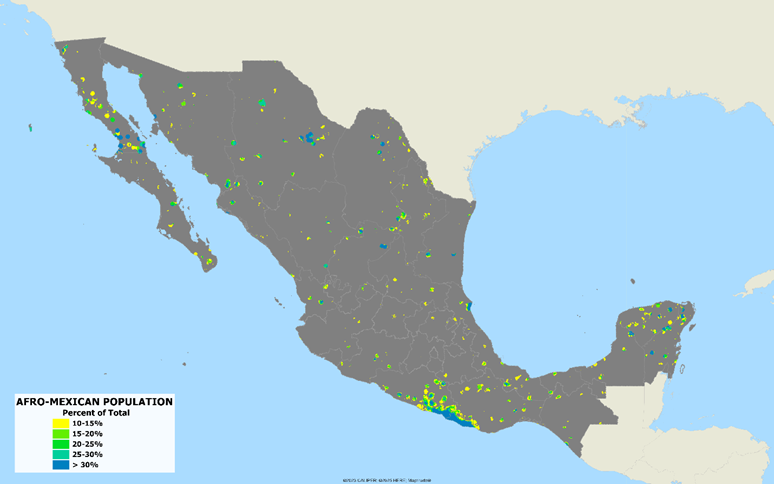
- The largest concentration remains in the Costa Chica (“small coast”) of Guerrero and Oaxaca states, roughly from Acapulco to Puerto Angel. Prior to the construction of Federal Highway 200 along the coast, this area was very isolated from the rest of the country, and many escaped slaves found refuge here.
- In Veracruz, those emancipated were absorbed into the local culture, but there remain several towns which were settled by escaping slaves in the mountainous western part of the state. The Veracruz area has a rich heritage which is a melding of indigenous, Spanish, and African cultures. The town of San Lorenzo de los Negros was renamed Yanga in 1932 to honor the leader of a 1570 slave rebellion and mass escape that resulted in the town’s founding.
- In northern Mexico, in Coahuila and along the Texas border, one of the branches of the underground railway resulted in the settling of both free and enslaved Black Americans both before and after the civil war. The town of El Nacimiento, in Coahuila, remains a significant concentration of Afro-Mexicans.