
Imagine for a moment that you have lived in a house for several years and decide that you should refinance your mortgage in order to renovate. The bank denies your application and calls the mortgage, arguing that you no longer have clear title to the property.
In good faith, you purchased the property from the previous owner, and the relevant authorities affirmed that you had clear title. And now you don’t.
This recently happened in Richmond, British Columbia, where a ruling in a native lands claim immediately clouded the legal title of hundreds of properties. This had immediate effects, none of them good (for example, https://www.canadianmortgagetrends.com/2025/12/cowichan-case-blamed-for-sinking-b-c-property-deals-including-luxury-hotel-purchase/). Nobody is going to buy a property with a clouded title, unless it is at a tremendous discount.
While the case in question explicitly included only government owned lands (known generally as ‘Crown lands’), other cases in Canada have gone further. The Wolastoqey Nation of New Brunswick has claimed over fifty percent of the province as their ancestral land and this extended beyond the Crown lands into the large landholdings of the Irving family, the province’s largest private landholder.
Aboriginal title rights are formally recognized in Canada through the Constitution Act of 1982. These are collective rather than individual rights that include lands which were regularly and exclusively occupied by an Indigenous group prior to the Crown’s assertion of sovereignty over the territories now comprising Canada. While many of these lands were ceded by treaty and likely off limits, much of the Crown land is in territories where treaties may not have been negotiated, where the Crown violated those treaties, or where the treaties were geographically vague.
To date, no court has ruled that the current owners are obligated to return those properties to the tribe or to be compensated for their appropriation, but this is likely just a matter of time. In the meantime, property owners in Richmond find themselves unable to sell or even refinance their properties because of cloudy titles.
If this was an isolated case, it might not be cause for alarm. Significant land claims which are currently working their way through the court system can be found in several provinces. These claims include all of the Atlantic provinces (New Brunswick, Nova Scotia, Prince Edward Island, and Newfoundland), nearly all of British Columbia, and significant sections of Ontario and Quebec. Competing and overlapping claims in New Brunswick cover almost all of the province, with land title records dating back nearly three centuries.
Included are the resource rich areas of northern Quebec and British Columbia. These claims affect not just rural areas, but major cities like Vancouver, Ottawa, and Kitchener-Waterloo.
As an example, the Haldimand tract in Ontario covers much of the Grand River basin and is the subject of ongoing disputes between the Six Nations and both the provincial and federal governments. It includes several significant cities, where development moratoriums could easily be imposed while these claims are negotiated (https://www.cbc.ca/news/canada/hamilton/haldimand-tract-development-moratorium-1.5993081).
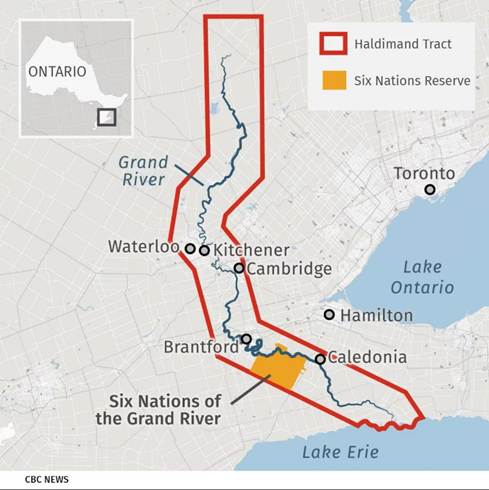
With the ruling in British Columbia last year, the flood gates have opened. Millions of Canadian property owners could find themselves battling title issues over the coming years.
Our goal here is not to take a position on these claims, but rather to consider the implications of these claims.
Settling claims may protect individual property owners by restoring clear title, but at substantial cost to all taxpayers. Regardless of the outcome of these claims, much of the country now exists under conditions where private ‘fee simple’ titles are in conflict with collective aboriginal title rights. At best, this will drain the public coffers while at worst throw private property ownership into chaos. At present, courts are providing conflicting rulings which serve only to cloud the issue and its potential avenues for resolution.
Given that most of our readers are in the United States, why should you care?
Foreign companies wishing to expand operations into Canada may not be aware of these claims, which have been rarely covered by the media or treated as anomalies. Investment decisions in Canada must include an assessment of the risks of such claims. With recent court decisions, the situation has become more unsettled and likely to lead to widespread claims against private land holdings in the future.
In the United States, the concept of aboriginal title rights has long been recognized but have been severely curtailed legislatively. There remain disputes, including potential challenges to the Alaska Native Claims Settlement Act (1971), unratified treaties in California (covering 7% of the state), and many smaller claims. In recent years, the Department of the Interior has been engaged in a buy-back program for tribal nations which returned over 3 million acres of federally owned land as of 2023 and paid out well over $1.6 billion in compensation. In other words, property owners in the United States are not immune from land claims which may date back several centuries, as all it takes is one court case to challenge the legitimacy of a treaty or long-standing legislation to reopen issues which many thought were settled decades ago.