
The population of Mexico is estimated at 134.4 million people, which is significantly up from the 126.0 million enumerated in the 2020 census. Much of this change has been in the last two years – at least partly due to US border policy changes which have resulted in return migration from the United States and continued migration from Central America into Mexico.
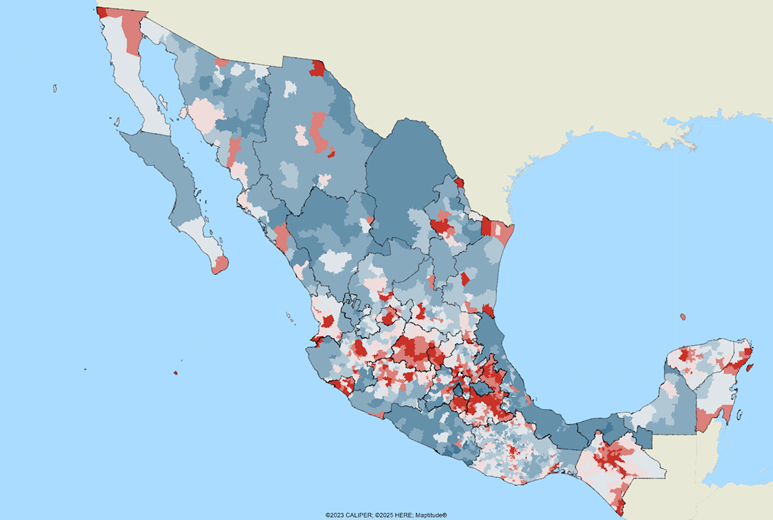
The distribution of change as seen at the municipio level in the map below, can be summarized as follows:
- Continued decline in most rural areas, especially in the arid north and in the Veracruz area, or in areas which have significant crime issues related to the cartels
- Growth in the suburban areas of Mexico City, Guadalajara, and Monterrey, even while the population of federal district has declined.
- Rapid continuing growth in the main tourism centered areas of the Yucatan Peninsula, the Puerto Vallarta and Manzanillo regions, and Baja California (Cabo San Lucas, Ensenada)
- Substantial growth along the northern border with the United States – most notably in Tijuana, Juarez, and Reynosa. Along the southern border, the towns of Chiapas and southern Quintana Roo have seen substantial growth in the last year.
Mexico is changing quickly under its current administration.
Several significant infrastructure projects are planned or underway in Mexico which will have significant impacts on regional growth over the coming years. Historically, the main transportation routes have radiated out from Mexico City – connecting the densely populated capital city with ports on both coasts. Mexico is investing heavily in core infrastructure – road and rail transportation, energy, and ports. These will improve the economic position of the country as a whole, but will also have significant regional effects:
- A dedicated, elevated high speed corridor between Monterrey and Laredo, Texas which will significantly improve transit times between the industrial centers of Nuevo Leon and their markets in the United States. The northeastern border states will likely see continued growth over the coming decades.
- A multimodal link between the ports of Coatzacoalcos and Salina Cruz, intended to be an alternative to the Panama Canal. If this is successful in being both completed and able to reroute freight from the Panama Canal, we would expect to see significant growth in the port cities on both sides and significant regional development in the relatively stagnant ports of the state of Veracruz.
- The Tren Maya, which is under construction from Chiapas to Cancun, will further promote tourism and industrial development in the region, and will better link the Yucatan Peninsula to the more highly developed areas to the west and north.
- Significant improvements in linking coastal cities to each other rather than just to Mexico city
- Improvements in key ports which support the Mexican oil industry
Mexico should be an important market to watch over the coming years, and both foreign and domestic investors in that economy will continue to rely upon quality demographics to guide their steps.