
This week, we are featuring the first in a series of articles by guest writer, Brett Lucas. Brett Lucas is a geospatial professional with expertise in urban and rural planning, economic analysis, big data analysis, Geographic Information Systems, cartography, data visualization, spatial analytics, and business/economic research within a geospatial environment. He currently serves as Director of Research with the Greater Des Moines Partnership.
Most retail systems are built around density.
More people usually justify more stores, more competition, more variety. That logic works well in cities, where proximity and foot traffic drive everything from grocery stores to restaurants.
But rural Wisconsin doesn’t work that way.
And neither does Kwik Trip.
A System That Isn’t Built for Density
Large parts of Wisconsin are defined by low population density, small towns, long travel distances, and uneven settlement patterns.
This creates a problem most retail systems aren’t designed to solve.
You can’t rely on clustering.
You can’t rely on walk-in traffic.
And you can’t assume another option is nearby.
Yet despite those constraints, Kwik Trip has built one of the most consistent and widely distributed retail networks in the state.
That’s not accidental.
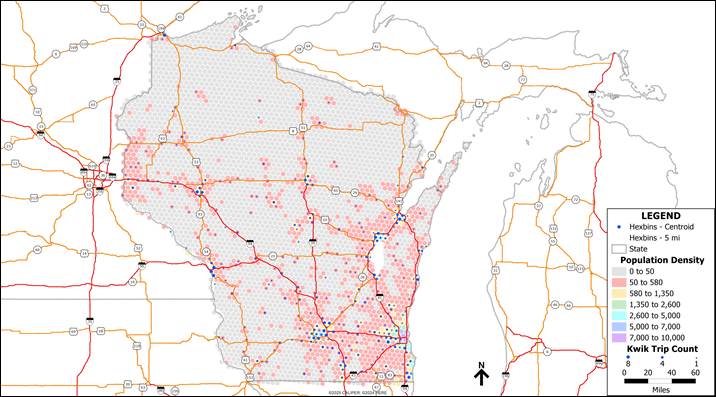
Map #1 – Retail Without Density: Kwik Trip’s Presence Across Wisconsin
The Pattern Isn’t What You’d Expect
If retail followed density alone, most stores would cluster tightly around Milwaukee, Madison, and a handful of regional cities.
Some do, but Kwik Trip doesn’t stop there.
Across Wisconsin, stores extend well beyond major population centers:
- along highway corridors
- in small towns
- in areas where population alone wouldn’t typically justify it.
This isn’t a scattered pattern. It’s systematic.
Kwik Trip doesn’t simply follow demand, it builds coverage.
What Matters Isn’t Where Stores Are, It’s How Far Away They Are
Location maps can be misleading.
In rural areas, access matters more than location.
When you shift the analysis to drive time to the nearest store, the logic behind the network becomes clearer.
Across much of southern Wisconsin, access falls within 5–10 minutes.
Even in less dense regions, large portions of the population remain within 10–15 minutes.
There are gaps, particularly in the far north, but they are relatively contained given the geography.
This is the key difference:
- Urban retail optimizes for concentration.
- Rural retail has to optimize for coverage.
Kwik Trip is doing the latter, and doing it consistently.
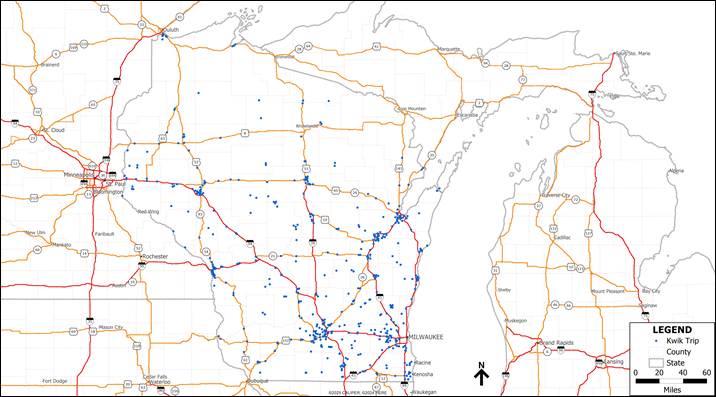
Map #2 – Not Clusters – A System: How Kwik Trip Covers Wisconsin
Why That Changes What a “Convenience Store” Is
Once you build for coverage instead of clustering, the role of each location changes.
In cities, a convenience store is optional.
In rural areas, it becomes essential.
That’s where Kwik Trip’s model starts to look less like retail, and more like infrastructure.
In many parts of Wisconsin:
- the closest hot meal is a Kwik Trip
- the most reliable food option is a Kwik Trip
- the default stop between towns is a Kwik Trip
This isn’t just gas or snacks, it’s filling missing pieces of the system.
The System Works Because It Matches the Geography
What Kwik Trip is doing works because it aligns with how rural areas actually function.
Small differences matter more
In low-density areas, a few miles, or a few minutes, can determine whether something is usable.
Trade areas aren’t clean shapes
People don’t move according to county lines or ZIP codes. Travel follows roads, habits, and constraints.
Reliability beats variety
Urban systems compete on choice. Rural systems compete on consistency.
The goal isn’t to offer everything, it’s to make sure something is always close enough.
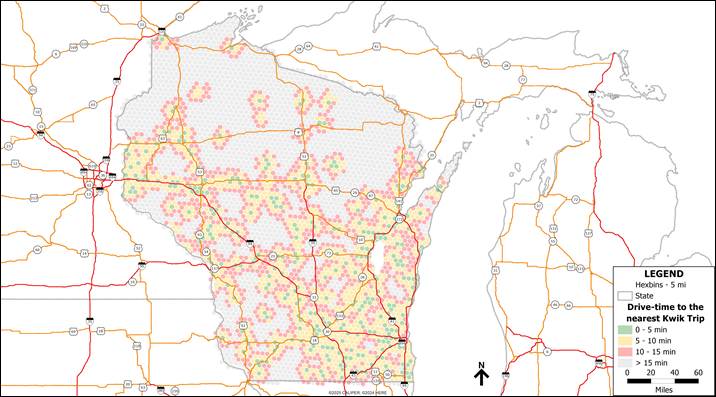
Map #3 – Designed for Access: Drive Time to the Nearest Kwik Trip
What This Tells Us
Kwik Trip isn’t just a successful chain. It’s an example of what happens when a system is designed around rural reality instead of urban assumptions.
It prioritizes:
- coverage over clustering
- proximity over density
- consistency over variety
And in doing so, it fills gaps that other systems leave behind.
That has implications far beyond convenience stores.
Because when you look at other services, like healthcare, the question becomes harder to ignore:
Why aren’t more systems built this way?