September 15 marks the beginning of National Hispanic Heritage Month, a celebration that runs through October 15. It began as Hispanic Heritage Week under President Lyndon Johnson in 1968 and was expanded to a 30-day observance under President Ronald Reagan in 1988. But although Hispanic heritage has deep roots in the United States, the terminology used to describe it is comparatively new.
Go back in time to 1975 and ask someone what was meant by “Hispanic origin,” and there is a good chance the phrase would have been unfamiliar. The term was developed and standardized by the federal government as it sought a way to identify several growing populations with connections to Spanish-speaking countries. Grace Flores-Hughes, who worked in what was then the Department of Health, Education, and Welfare, is often credited with helping introduce the term “Hispanic” into federal usage.
The label was intended to encompass groups including Mexican Americans, Puerto Ricans, and Cuban Americans. Yet these populations were never a single cultural or ethnic group. They came from different places, followed different migration patterns, and developed distinct communities within the United States.
The Census Bureau’s approach evolved alongside the terminology. With the notable exception of the 1930 Census, which briefly listed “Mexican” as a race, early censuses did not include a category resembling today’s Hispanic-origin question. The 1970 Census asked a sample of households whether each person’s origin or descent was Mexican, Puerto Rican, Cuban, Central or South American, other Spanish, or none of these. In 1980, “Spanish/Hispanic origin or descent” appeared on the form sent to every household. Census 2000 broadened the wording to include “Spanish/Hispanic/Latino.”
So, what does Hispanic origin actually mean?
In general usage, “Hispanic” emphasizes an ancestral or cultural connection to Spain or Spanish-speaking countries, while “Latino” emphasizes origins in Latin America. That creates some interesting distinctions: someone from Spain may be considered Hispanic but not Latino, while someone from Brazil may be considered Latino but not Hispanic. In practice, however, identity is personal, and people may prefer Hispanic, Latino, a more specific national origin, another term, or no broader label at all.
One of the most important—and frequently misunderstood—points is that Hispanic origin is treated as an ethnicity, not a race. A person may be Hispanic and White, Black, American Indian or Alaska Native, Asian, Native Hawaiian or Other Pacific Islander, multiracial, or another race.
That distinction has created persistent challenges for Census respondents. For decades, many Hispanic respondents selected “Some Other Race,” in part because the available race categories did not reflect how they understood their own identities. The 2020 Census added examples and expanded the collection and coding of detailed responses for both race and Hispanic origin. Those improvements produced much more detailed data and contributed to a substantial increase in the population reported as multiracial. They also make direct comparisons with earlier censuses more complicated.
What has not changed is the remarkable growth of the Hispanic population. In 1980, 14.6 million people—6.4% of the country—identified as Hispanic. That increased to 22.4 million in 1990, 35.3 million in 2000, 50.5 million in 2010, and 62.1 million, or 18.7% of the population, in 2020. AGS estimates the 2026 Hispanic population at approximately 65.9 million, representing 19.3% of the nation.
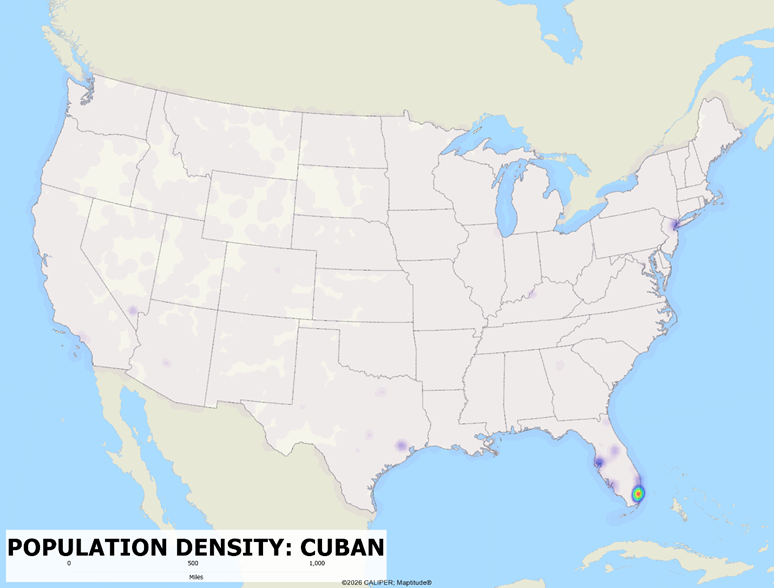
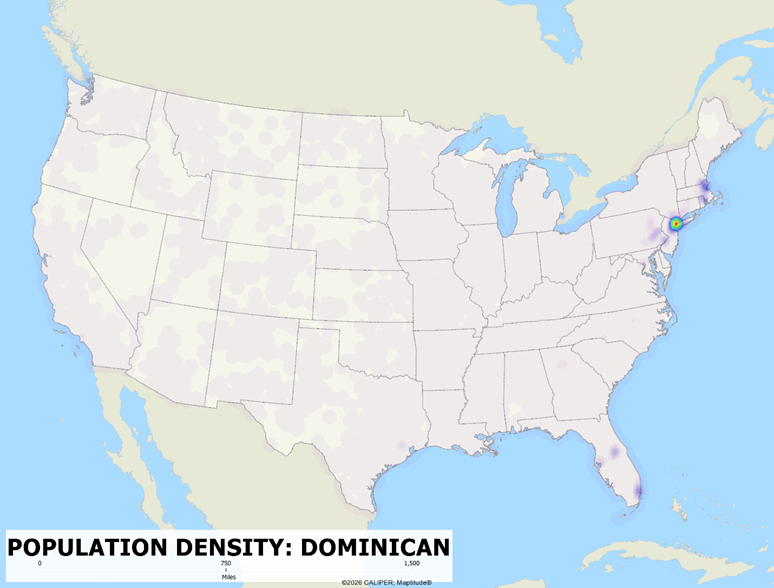
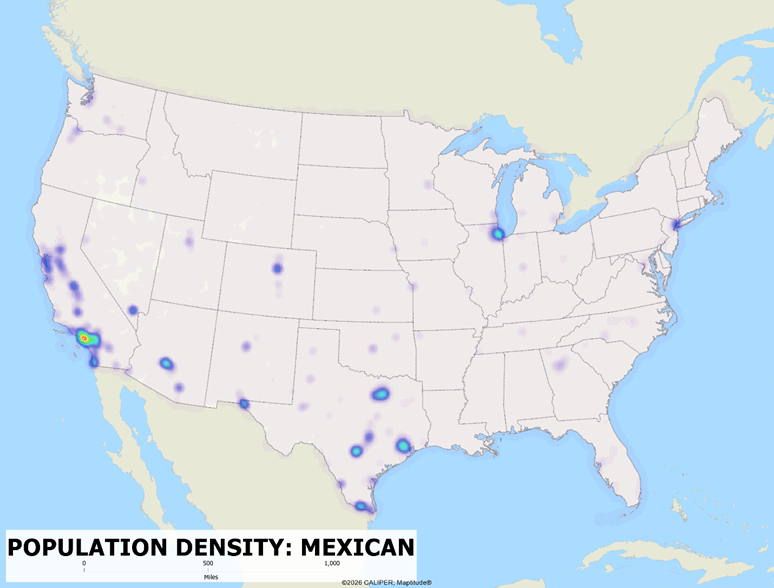
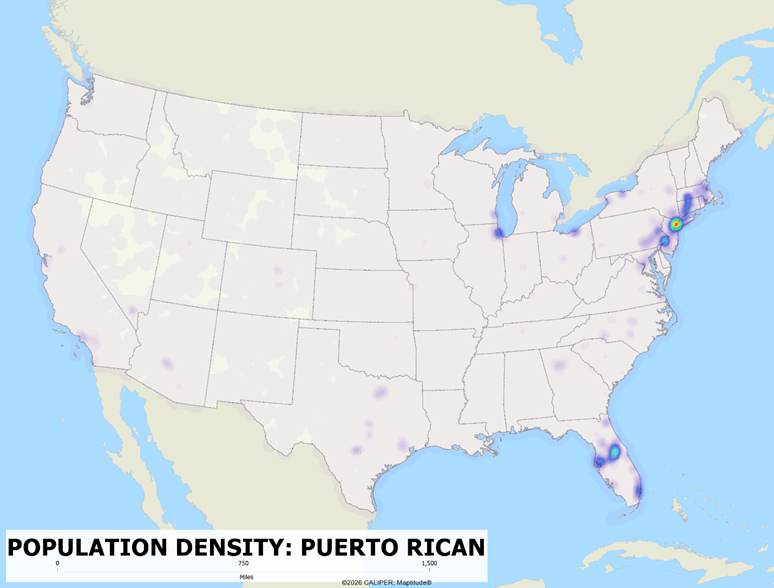
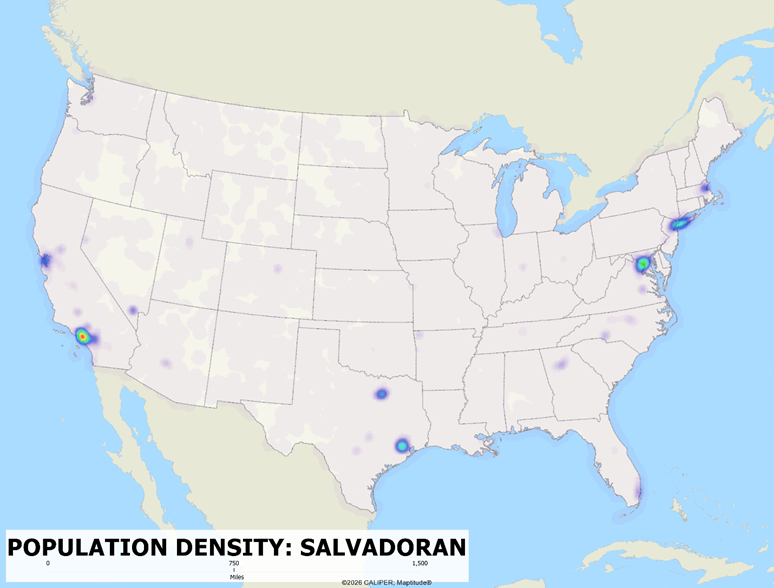
Mexican origin remains by far the largest component, accounting for an estimated 57.3% of the Hispanic population in 2026. Puerto Ricans account for approximately 9.0%, followed by Cubans at 4.3%, Salvadorans at 4.1%, Dominicans at 3.7%, and Guatemalans at 3.2%. These figures reinforce why “Hispanic” should never be interpreted as a monolithic identity.
The geography has changed just as dramatically as the population totals. In 1990, areas with large Hispanic shares were heavily concentrated along the Mexican border and throughout the Southwest, in South Florida, and around the New York–New Jersey metropolitan region. These patterns reflected the country’s largest Mexican, Cuban, and Puerto Rican communities.
By 2026, the same broad foundations remain visible, but the map has filled in considerably. Hispanic communities are now present throughout nearly every major metropolitan area, with especially noticeable expansion across Texas, the Southeast, the Mountain West, and eastern Washington. What was once concentrated in a relatively limited number of regions has become a truly national population.
Looking at individual origins reveals an even richer geography. Mexican, Puerto Rican, Cuban, Salvadoran, Dominican, and other Hispanic populations each have distinct settlement patterns shaped by migration, employment, family networks, and history. The national label may be useful for measuring broad demographic change, but the detailed data tells a more meaningful story: there is no single Hispanic America, but many communities, each with its own history and geography.