
Understanding ‘daytime demographics’ has long been considered an important component of location analysis, especially for retail and restaurant chains for which demand from workers rather than residents is a significant component of business. For most of our thirty years, AGS has provided one or more business/daytime databases that focus on establishments and their employees. The information available on those employees has been limited to estimates of employment by occupation.
At the same time, we have long been aware of a program in the Census Bureau that compiles detailed information on workers – where they live, where they work, and some simple demographics. The Longitudinal Employer-Household Dynamics (LEHD) program is an interesting cooperative effort between the federal and state governments that utilizes data from state unemployment insurance programs (https://lehd.ces.census.gov/).
While several important datasets have come out of the LEHD program over the years, we are primarily interested in the LODES (LEHD Origin-Destination Employment Statistics) program, which provides data on the residence and workplace locations of workers, at the census block level. The LODES data has always been daunting to assemble and utilize, and has been largely ignored for several reasons:
- For any given year, there are thousands of files for each state, with separate sets of tables for workers who cross state lines
- While all states have participated at some points in time, there are a few states which have dropped participation in recent years (Alaska, Mississippi, and Michigan)
- Coverage is complex and does not align with standard estimates of the total labor force.
While it is probably the complexity and volume of the data structures that deters usage, it is the second two points which can complicate interpretation. The database covers all workers subject to unemployment insurance, some 140 million in the most recent release. Some things to keep in mind here –
- Workers not subject to unemployment insurance (farming, self-employment) are not included in the database
- Some workers have multiple jobs and are in effect double-counted
- Work from home is difficult to capture, since such workers are often “assigned” to offices which they rarely frequent
Problems aside, we view this as a significant source of data which will be useful for site location analysts, transportation planning, and economic development agencies. A simple analysis computes the ratio between “stayers” and “leavers” for an area as –
Live Here/Work Here + Live Elsewhere/Work Here
Live Here/Work Elsewhere
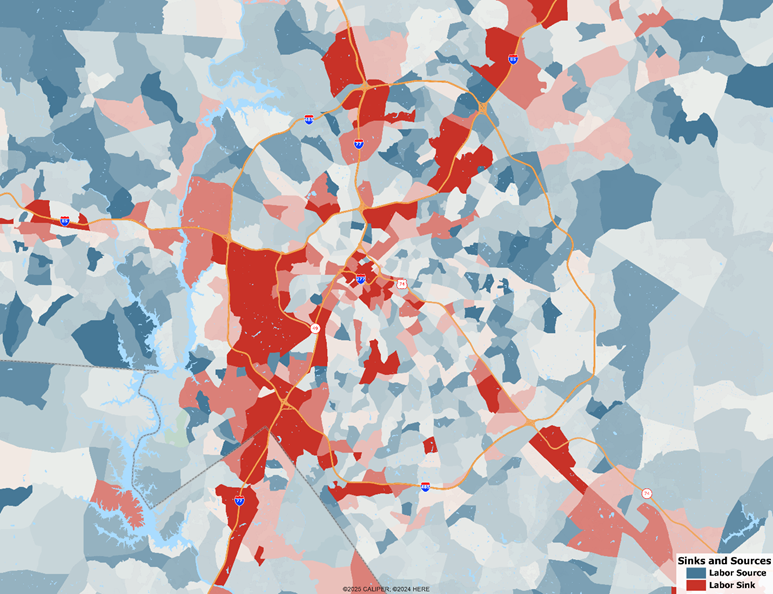
Areas which attract workers, or retain local residents, are termed “sinks” and areas where residents leave to work elsewhere are termed “sources”. At the metropolitan level, there are several different patterns which are clear – the central business district focused city (NY) and the dispersed beltway style city (Charlotte, NC) are shown below:
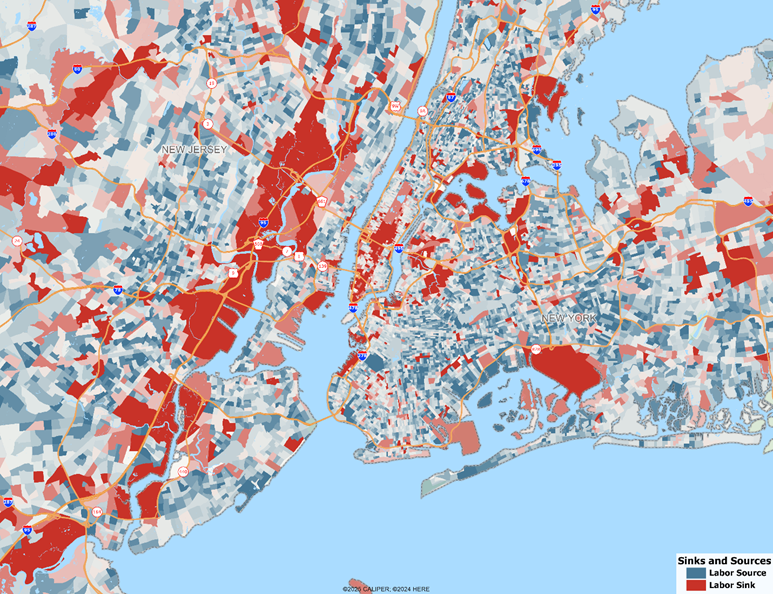
Note that even a very heavily downtown oriented city like NY has major employment locations elsewhere, usually along major freeways. Contrast this with Charlotte, which has a downtown that competes with employment locations along the beltway.
Over the coming weeks, we will present several case studies which utilize the data and answer the following types of questions:
- How many people in this trade area live elsewhere and work here, live here and work elsewhere, and live here and work here, and how has this changed over time?
- What are the demographic characteristics of the daytime population? Here we will consider our segmentation and analytics databases – Panorama and Dimensions – as they apply to the daytime population, as well as focusing on the income characteristics of workers
- What are the patterns of commuting in a particular city and how do they contribute to traffic flows and retail analysis?