
Despite what you might think, Tabasco sauce did not originate in the southern Mexican state of Tabasco. It was created in the 1860’s by Edmund McIlhenry in Louisiana, using a chili variety native to Tabasco. Having attempted to grow the chilis in Louisiana, the company later contracted with farmers in Tabasco to provide the basis for this famous hot sauce.
But Tabasco is one of the original locations where cacao was cultivated, and the state still produces some of the world’s finest chocolate and hosts an annual chocolate festival in Villahermosa.
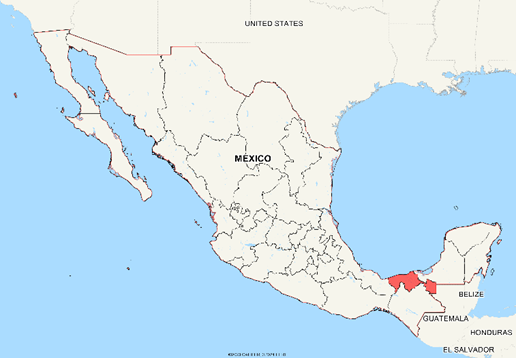
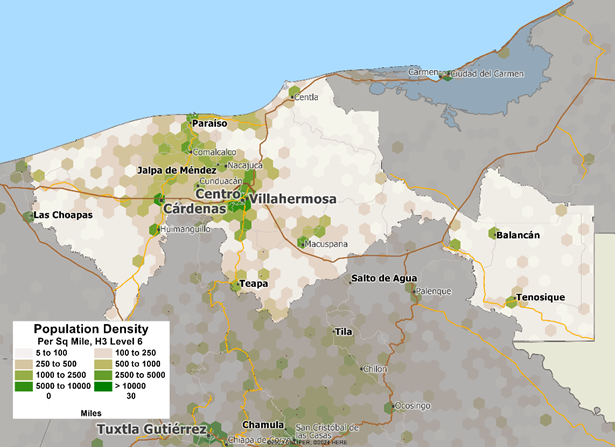
Tabasco, officially the Free and Sovereign State of Tabasco, was one of original fourteen states of Mexico which declared independence from Spain in 1821. The population is more rural than many states, with the population heavily concentrated in the centrally located cities of Villahermosa and Cardenas, which together comprise the metropolitan zone of Villahermosa, with 900,000 people.
The current population of the state is just over 2.5 million, with a median household income of $M 145,000, significantly below the Mexican average of $M 191,000. As with other southern Mexican states, the population growth has been well above average over past several years.
Much of the state is a low lying coastal plain, and the UNESCO designated Pantanos de Centla Biosphere Reserve in Tabasco is one of the largest wetland systems in North America. It’s a vast tropical swamp filled with crocodiles, manatees, jaguars, and hundreds of bird species—so biodiverse that UNESCO designated it an international biosphere reserve.
Only in recent decades has the region been easily accessible to the rest of the country through the development of Federal Highway 180 which was only completed through Tabasco in the 1950’s, facilitating the development of the oil and gas industry, upon which the state is now heavily dependent. The state’s flat terrain and river systems support agriculture, but flooding frequently disrupts infrastructure and economic activity.
Challenges for the state in the future include declining hydrocarbon output and limited diversification of its economy. Agriculture remains difficult given the regular flooding of much of the state.