Finding the right place to live requires a little research. How expensive are the homes? What is there to do nearby? Will the neighbors be a good fit? Those questions become a little more complicated when you sleep in a coffin, travel by broomstick, or prefer your home already abandoned. This Halloween, we thought we would help the immortal world by answering an unusual site selection question: where should ghosts, vampires, and witches call home?
We created a Quality of Life Index for each creature, combining demographic, housing, business, and environmental variables with a few supernatural preferences. Each variable was scored on a national percentile basis from 0 to 100 at the block group level, then averaged into a creature-specific score. For mapping, we aggregated those scores into an H3 Level 5 hexagon grid, roughly 10 miles across. Hexagons with 10 or fewer homes were left blank. On each creature’s map, darker colors indicate more attractive places to settle down—or rise again.
For ghosts, the ideal neighborhood offers peace, quiet, and a little history. We favored higher death rates, older and vacant housing, population loss since 2010, and darker, quieter surroundings. Noise and nighttime light measures from our upcoming 2026B Environment release helped identify places where a ghost could haunt without competing with traffic or a brightly illuminated parking lot. An empty old house certainly has potential. An empty old house on a quiet, dark street? Now we’re talking.
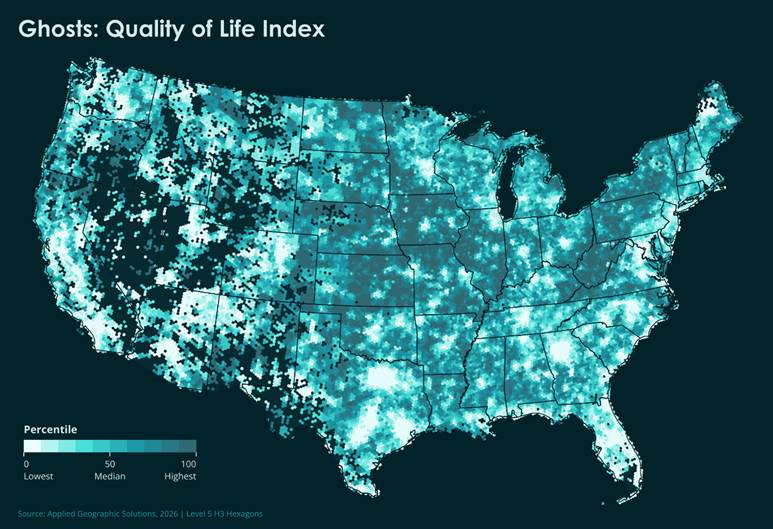
Among the 826 cities with populations of at least 50,000 in our analysis, Youngstown, Ohio, claimed the top ghost ranking, followed by Parma, Ohio, and St. Joseph, Missouri. At the metropolitan level, Wheeling, West Virginia–Ohio, narrowly edged out Johnstown, Pennsylvania, with Weirton–Steubenville, West Virginia–Ohio, taking third. These rankings reflect the combined appeal of our selected conditions to a fictional house hunter with very different priorities from the average buyer.
Vampires have a more social checklist. They need people nearby and somewhere to spend the evening, so we included population and nightlife within one mile. Older, affordable homes earned higher marks, along with lower sunlight and fewer nearby places of worship. Even an immortal can appreciate a reasonably priced home with architectural character, especially when dinner and entertainment are conveniently close.
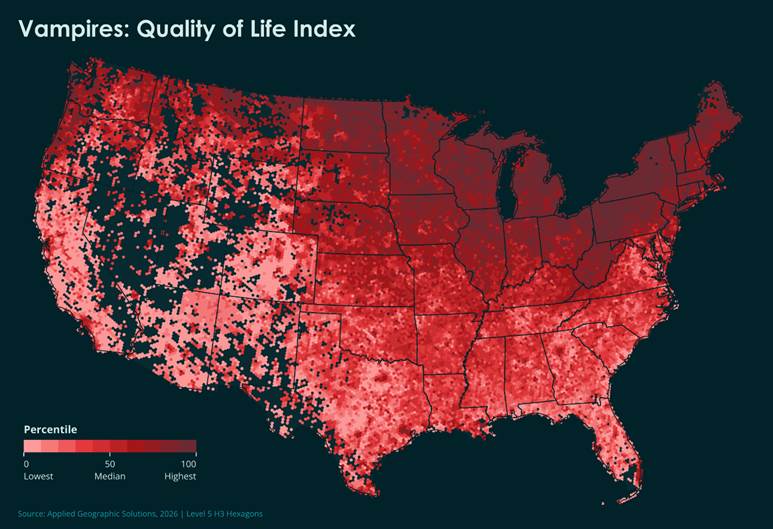
Buffalo, New York, topped the vampire city rankings, followed by Berwyn, Illinois, and Scranton, Pennsylvania. St. Clair Shores, Michigan, and Erie, Pennsylvania, rounded out the top five. The metropolitan rankings offered another strong showing for New York: Elmira placed first, Buffalo–Cheektowaga second, and Binghamton third. The vampire map shows broad appeal across much of the northern United States, although local differences still matter. A favorable climate alone doesn’t guarantee a lively evening within easy reach of the crypt.
Our witches required the most eclectic shopping list. Nearby woods provide atmosphere, while gardens and nurseries offer ingredients for the next potion. Sawmills made the list for broomstick supplies. We also favored more children ages 0–9, fewer rainy days, less nearby water, and higher concentrations of Hipsters & Geeks and Olde New England households from Panorama. For this fairy-tale-inspired exercise, we assumed witches appreciate both woodland surroundings and neighbors with a little character. We also assumed they would rather avoid melting.
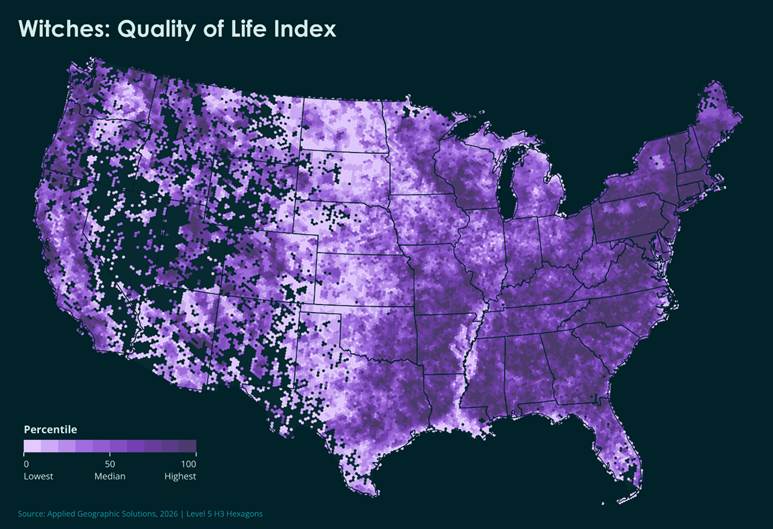
Waterbury, Connecticut, took first place among cities for witches, followed by Vineland, New Jersey, and Cupertino, California. Joplin, Missouri, and Gilroy, California, completed a geographically varied top five. Waterbury–Shelton also led the metropolitan rankings, followed by Chambersburg, Pennsylvania, and Vineland. Evidently, there is more than one kind of neighborhood where a witch can put down roots.
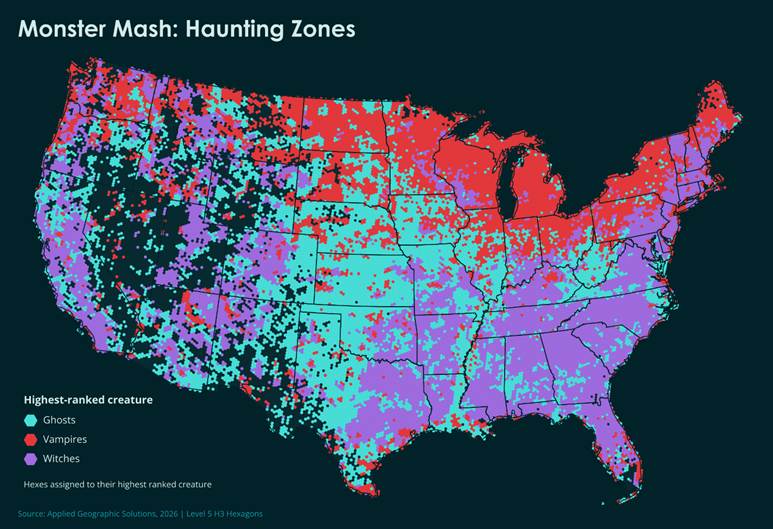
Finally, our Monster Mash map assigns each hexagon to the creature with the highest score there, revealing a patchwork of potential haunting zones. That designation shows which creature is the best fit locally; it doesn’t necessarily mean the location is a national favorite. The exercise is playful, but the underlying geography is useful: different priorities produce different maps. Whether you’re selecting a store location, evaluating a neighborhood, or searching for somewhere to park a broom, the right place depends on what matters to you.