
Puerto Rico has been a territory of the United States since 1898, when it was acquired from Spain in the Treaty of Paris. A 1917 law established citizenship for residents of American territories, and migration to the mainland began in earnest at the end of WWII.
Despite outmigration, the population of the island grew over the decades, reaching a peak by about the year 2000, after which the population has declined consistently each year. The cause is both net outmigration and declining fertility –
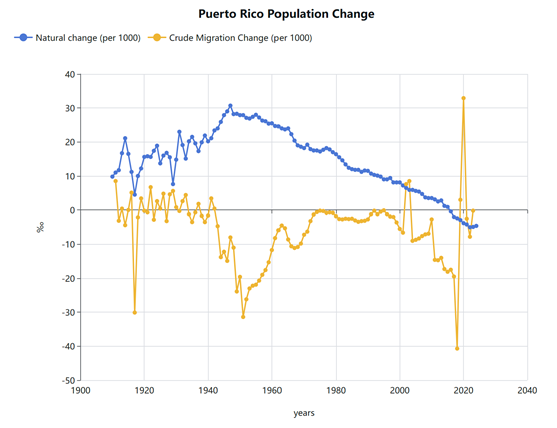
While the decline in fertility is not dissimilar to most of the western world, net migration has been consistently negative for decades, with a couple of single year exceptions. Puerto Ricans have left the island because of both push and pull factors. The reasons are many, but include:
- Agricultural displacement due to the concentration on sugar production, while increasing agricultural imports and costs to residents.
- The expiration in the early 2000’s of federal tax incentives to companies locating facilities on the island resulted in a multi-year recession with high unemployment and a crippling public debt crisis from governments who had gambled on federal tax dollars and continued growth.
- Natural disasters, such as the 2017 Hurricane Maria, left residents without critical services (power, water, schools) for months in some parts of the island. Given the restructuring of debt, the island government lacked the resources to rebuild infrastructure. Critical services – water and power – are now unreliable.
- Since Puerto Ricans are fully citizens of the United States, there are no barriers to exit aside from the cost of transportation. Many leave the island – degrees and diplomas in hand – in their early 20’s and do not return.
The result is a self-reinforcing downward economic and demographic spiral. The population is increasingly older and not participating in the labor force, putting additional burdens on an already burdened government which cannot afford to repair, let alone improve, the decaying infrastructure. Lower external investment completes the cycle.
As a result, the number of Puerto Ricans in the mainland states exceeded the island population by 2010 and is now approaching a two-to-one ratio.
| Puerto Rico | Mainland States | |
| 1950 | 2,210,703 | 226,110 |
| 1960 | 2,349,544 | 892,513 |
| 1970 | 2,712,033 | 1,391,463 |
| 1980 | 3,196,520 | 2,014,000 |
| 1990 | 3,522,037 | 2,728,000 |
| 2000 | 3,808,610 | 3,406,178 |
| 2010 | 3,725,789 | 4,623,716 |
| 2020 | 3,285,874 | 5,601,863 |
| 2026 | 3,175,000 | 5,917,573 |
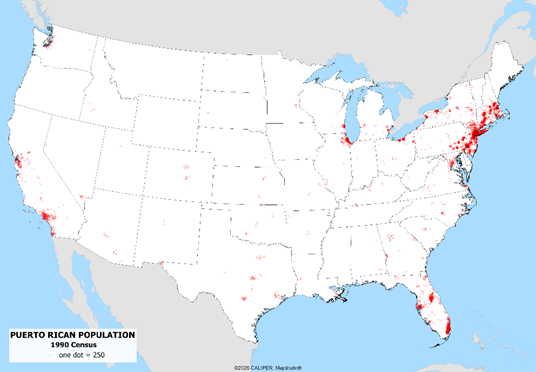
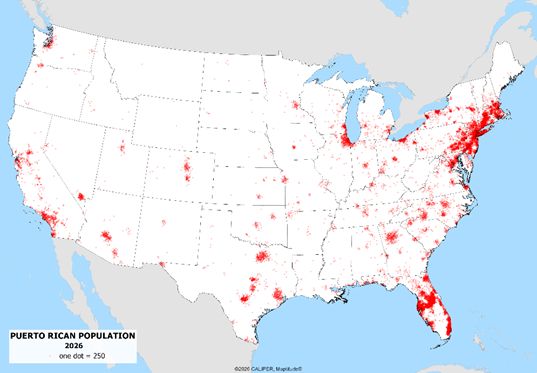
While increasingly dispersed in the mainland states, several significant concentrations remain –
- Central Florida, primarily along the I-4 corridor from Tampa to Orlando
- New York City, particularly in the suburbs of New Jersey and Connecticut
- South Florida
- Eastern Pennsylvania
- Eastern Massachusetts
The population is largely urban, with high concentrations in Springfield MA (21%), Vineland NJ (15%), Lakeland-Winterhaven FL (13%), Orlando (13%), and East Stroudsburg PA (12%). The maps below show the distribution of Puerto Ricans in the mainland states for 1990 and 2026:
What would stop the decline? The island desperately needs investment by companies who will bring jobs and tourists. Puerto Rico should be one of the top destinations for American tourists, who instead are headed to Mexico and the Dominican Republic. In order to entice the large resorts to build, the infrastructure problems must be resolved.
Puerto Rico is in a catch-22 here – it lacks the political clout to get federal projects but is subject to many laws which hamper competition with Caribbean neighbors – everything from labor laws to building standards. A resort developer can more cheaply develop and operate in Jamaica or the Dominican Republic than here, and a Spanish speaking call center can be much less expensively run in Mexico or Costa Rica.
Statehood may not be a solution, at least not until the territory has been developed sufficiently to eliminate most of the income gap with its mainland neighbors. Independence would take away the federal dollars which do flow to the island, likely resulting in substantially increased hardship.
Those in D.C. who favor statehood must be willing to put substantial resources into the island and should include the reinstatement of tax incentives for American companies who choose to invest in the island economy. In truth, this should be the case for D.C. regardless of any intent to add a fifty-first state to the union.