
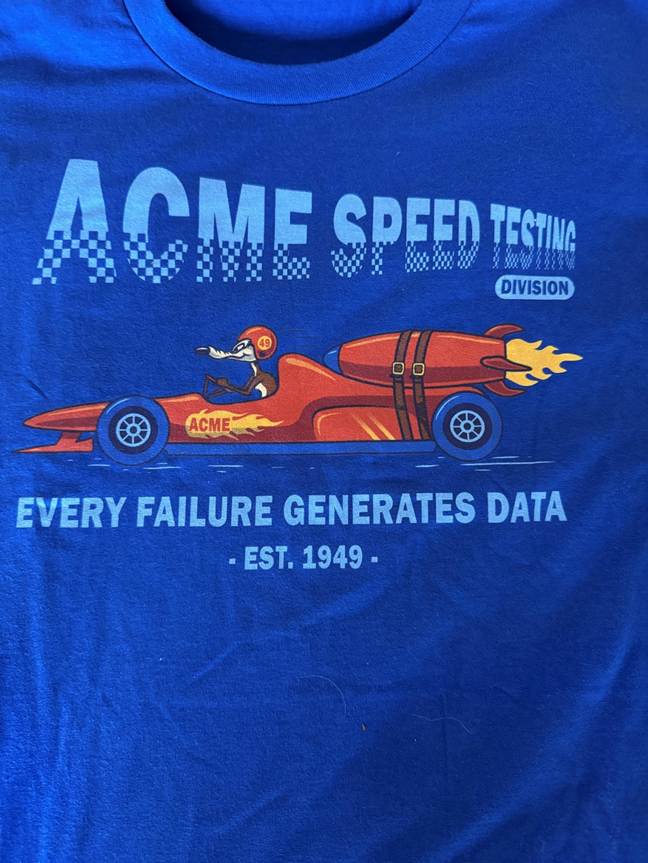
Last weekend, the oldest of my offspring gave me an unexpected gift that managed to bring together three seemingly disparate but important things in one small package. A T-shirt to be exact. It combines three of my favorite things – data, motorsports, and the best cartoons in history.
I grew up racing anything that we could add a motor on to, be it a boat, snowmobile, motorcycle or car. It is an incurable condition often passed on from one generation to the next. Yes, that is my son and I, driving 700 hp Hellcat’s on the Bondurant Track in Phoenix. Please do ignore the fact that he is in the lead.

The second element of the t-shirt? Wile E Coyote. Not the best Looney Tunes character by any stretch, but still better than the annoying mouse from the rival cartoon studio. The best is unquestionably Foghorn Leghorn. Nobody came close to matching the brilliance of Mel Blanc and Chuck Jones.
What does this have to do with data?
Everything.
Wile E. never seemed to learn from his mistakes, continuing to purchase wacky contraptions from the Acme Company that never worked.
One look at this shirt and I immediately knew how the three fit together:
Over several decades, I have been engaged to build retail sales forecasting and performance models. In some cases, I have been asked to fix models others have built, but that’s another story.
It always goes something like this – you ask for all their sales and locational data, by month, from the time that each location was opened. And what do they send you? Almost always a subset that excludes locations that have been closed.
When you ask them about data for closed locations, the responses are one of the following:
- Oh, why on earth would you want data for closed locations?
- We really don’t care about the past, only about the future.
- We would have included them, but the data for them has been removed from our systems.
- We excluded stores that we closed because the rent got too pricey, not because they performed poorly.
- My dog ate that data.
We humans are always reluctant to show the world our mistakes, and location analysts are no different. You can be sure that if they themselves pushed for a bad location, they would prefer to keep that quiet. If it predates them, it is likely the boss who would prefer to hide it. Rule #1: You must insist on getting data for all locations, past and present.
Missing data is most problematic if it is a biased sample, and in this case, it almost always is. This puts many companies in the position of our good friend Wile E, who just never seems to learn from his failed experiments.
Without question, including failed sites in retail sales models will substantially improve performance. Failures are always expensive and the primary goal is to avoid them in the future, because unlike Wile E., repeated falls to the bottom of the canyon will prove fatal.