
Canada has added nearly 4.5 million residents in just five years. The country’s population grew from 36,991,981 in 2021 to an estimated 41,471,991 in 2026—an increase of 12.1%, or nearly one million people per year. For a country accustomed to steady but comparatively modest growth, the pace is extraordinary. The vast majority of that increase has come from immigration, reshaping not only how quickly Canada is growing, but where that growth is occurring and how communities are absorbing it.
More than half of the new residents—53.2%—settled in Canada’s six largest metropolitan areas: Toronto, Montréal, Vancouver, Ottawa, Calgary, and Edmonton. Toronto alone accounted for 18.6% of the increase, followed by Vancouver at 9.4% and Calgary at 7.9%. These figures reinforce the pull of Canada’s largest employment, education, and immigrant communities, but the fastest growth rates reveal a more complicated geographic story.
Among metropolitan areas with more than 50,000 residents, Calgary grew the fastest at 23.8%, followed by Charlottetown at 22.6%, Moncton at 21.8%, Brantford at 21.5%, and Kitchener–Waterloo at 20.6%. Edmonton, Saskatoon, Brandon, Chilliwack, and Halifax also posted gains of at least 16.7%. Calgary and Edmonton may not be surprising, given Alberta’s economic strength and comparatively attainable housing. But growth above 20% in Charlottetown and Moncton is remarkable. It shows that Canada’s recent population boom is not limited to the largest global cities; it is also transforming smaller regional centers that may have far less infrastructure available to accommodate rapid change.
Only two metropolitan areas declined: Dolbeau-Mistassini and Sept-Îles, both relatively small and remote communities in Québec. Even then, the losses were modest—Sept-Îles declined by only about 120 people. At a national level, the pattern has three distinct parts: continued weakness in many rural and remote communities, unprecedented expansion in major metropolitan areas, and broad growth across the cities of southern Ontario, from Peterborough in the east to Windsor in the west.
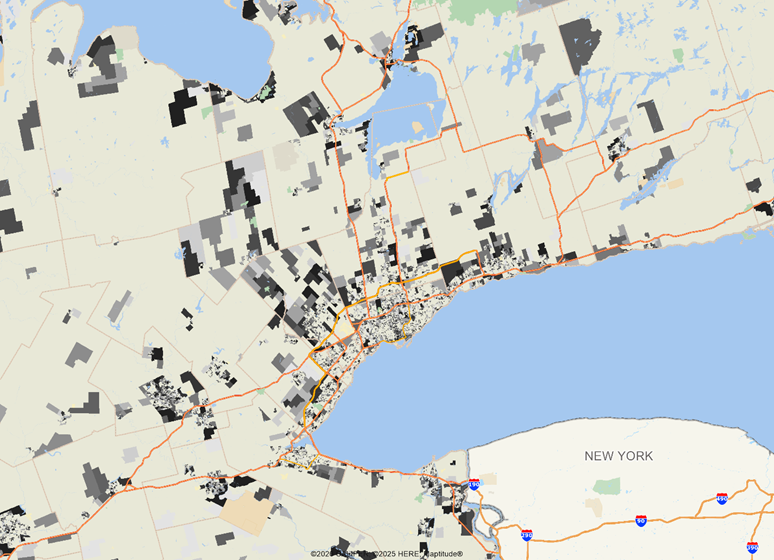
The maps below show only dissemination areas that grew by at least 10% between 2021 and 2026. In southern Ontario, growth appears in downtown Toronto and along subway corridors, where infill and higher-density development have created room for more residents. But it also reaches far beyond the traditional metropolitan footprint—to communities along the southern shore of Georgian Bay, west toward Owen Sound, and north and east through Orillia and Peterborough. Some of this may reflect retirees leaving the city, while hybrid work has also made it more practical for some households to live a few hours from Toronto and commute less frequently.
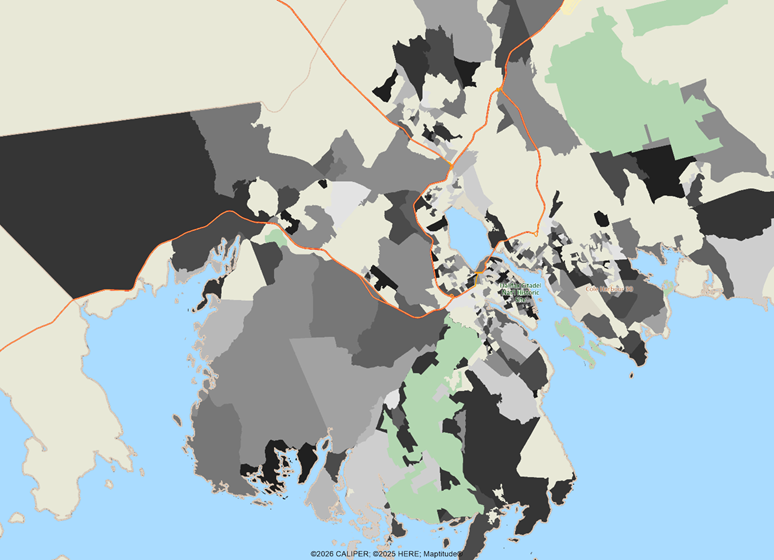
Halifax presents a similar story at a different scale. Growth is no longer concentrated near the historic urban core surrounding the harbor; it is spreading well into the region’s outer communities. That expansion can broaden access to housing, but it also creates new demand for roads, transit, schools, utilities, and public services in places that were not built for such a rapid influx.
The effects extend well beyond population counts. Economic output has not increased at the same pace as the number of residents, creating a disconnect between aggregate growth and the experience of individual households. Average incomes have improved, but those gains have been tempered by growth in the number of lower-income households. Newcomers may face language barriers, difficulty transferring professional credentials, and a challenging path into the labor market. Canada’s stronger social safety net can soften the effects, but it cannot fully offset high housing costs or weak income growth on a per-person basis.
Immigration is also changing Canada’s linguistic balance. Many newcomers initially speak neither English nor French as their primary language, although that typically changes over time as families integrate into schools, workplaces, and communities. The most significant long-term effect may be on French. The French-speaking population has remained relatively steady in absolute terms even as Canada’s total population has surged. With comparatively fewer newcomers choosing Québec outside Montréal or the Québec side of the Ottawa metropolitan area, Francophones represent a shrinking share of the national population. Despite longstanding efforts to preserve Canada’s bilingual identity, demographic momentum is gradually reducing the relative influence of French across the country.
Housing may be where the strain is most visible. Since 2021, Canada’s population has increased by 12.1% and the number of households by 11.9%, while the dwelling count has grown by only 2.9%. The mismatch has placed enormous pressure on both prices and availability in many of the country’s fastest-growing markets. Toronto illustrates the problem clearly: its population increased by 13.4%, but its housing stock grew by just 3.4%.
When population and household formation outpaced construction so dramatically, households adapt. Young adults remain at home longer, unrelated residents share units, and multiple generations combine under one roof. These arrangements may be a cultural preference for some families, but for others they are a practical response to limited supply and rising costs. Meanwhile, fast-growing smaller metros face many of the same pressures as Toronto and Vancouver without the same depth of transit, housing, and service infrastructure.
Canada’s growth between 2021 and 2026 is historically significant, but the headline number tells only part of the story. The country has successfully attracted millions of new residents, adding workers, consumers, entrepreneurs, and cultural vitality. The more difficult question is whether housing construction, infrastructure, labor markets, and public services can adjust at the same speed. Where the population has gone—and how well those communities accommodate it—will shape Canada’s economic and demographic geography for years to come.