
What do you picture when you imagine the “average American household”? An average income, an average household size, an average level of education? We use the word average constantly, but a household can be typical in one respect and highly unusual in another. Most rankings focus on extremes. We celebrate the wealthiest cities, the youngest neighborhoods, the fastest-growing suburbs and the best places for outdoor enthusiasts or young professionals. Nobody shows much love for the places in the middle. When hundreds of demographic, economic and lifestyle characteristics are considered together, where “average” actually exists might surprise you.
To find them, we used Dimensions, which distills approximately 800 demographic variables into 32 independent dimensions. These dimensions cover nearly every aspect of a community’s population, along with selected locational and environmental characteristics. Major factors such as affluence, life stage and urbanicity receive more weight than narrower variables, allowing the model to capture the characteristics that most meaningfully distinguish one place from another.
Each dimension is standardized around a national mean of zero. To determine how “average” a place is, we calculated its weighted absolute deviation from zero across all 32 dimensions. Looking at the absolute deviation is important because otherwise unusually high values in some categories could cancel out unusually low values in others, making a decidedly distinctive community appear average. Under this approach, the lower the score, the closer a place is to the collective American middle.
Among places with at least 10,000 residents, Naugatuck, Connecticut, emerged as the most average place in America. It was followed by Maplewood, Minnesota; Taunton, Massachusetts; and Cranston, Rhode Island. The top of the list includes plenty of smaller and midsized communities, which is not entirely unexpected. Smaller places can settle close to the national midpoint without containing the dramatically different neighborhoods found within a major city.
But average is not limited to small towns. Mesa, Arizona—with more than 527,000 residents—ranked fifth overall. Wichita, Kansas, with more than 408,000 residents, ranked seventh. Apparently, hundreds of thousands of people can live together without pushing a city particularly far toward any demographic extreme.
Because larger cities contain more internal variation, we also looked separately at places with populations above 100,000. Mesa and Wichita again claimed the top two positions, followed by Peoria, Arizona; Louisville, Kentucky; Omaha, Nebraska; Reno, Nevada; and Oklahoma City, Oklahoma. The list also includes two cities with populations above one million: Fort Worth, Texas, and Jacksonville, Florida. The map below shows those cities.
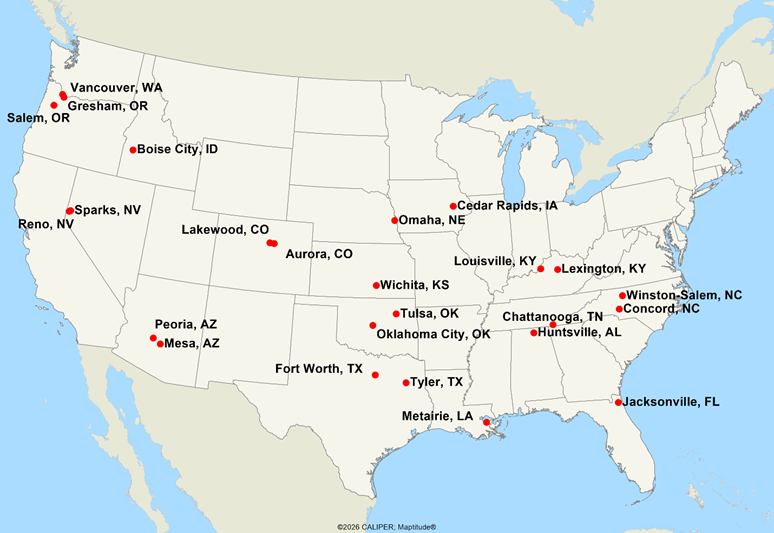
The geography of average is not random. Among smaller and midsized places, noticeable clusters appear in New England, northern Indiana and around the Dallas–Fort Worth metroplex. The larger cities are more geographically dispersed, although regional groupings still emerge around Phoenix, Reno–Sparks and Denver. In some cases, average appears to be a shared regional characteristic rather than an isolated local occurrence.
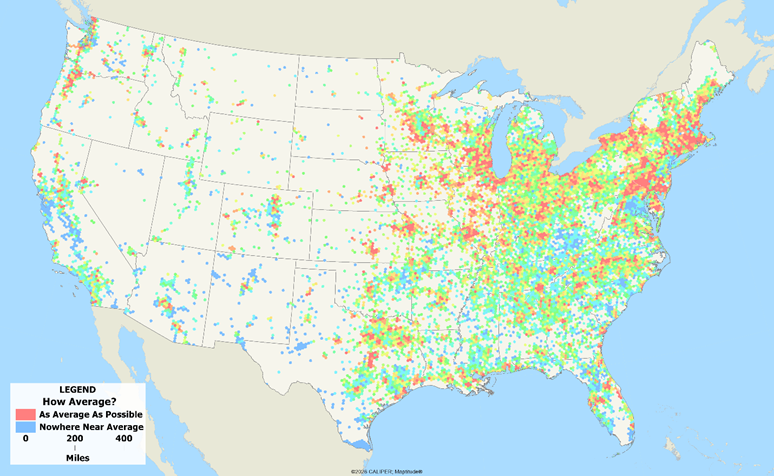
Mapping the results to Level 5 hexagons reveals the other side of the story: the parts of the country that are decidedly not average. Areas with the greatest departures from the national midpoint cluster throughout Appalachia, South Texas, California’s Bay Area and Central Valley, and portions of West Texas around Midland–Odessa and El Paso. These regions are very different from one another, but each possesses combinations of characteristics that set it apart from the country as a whole.
Of course, “average” does not mean ordinary, interchangeable or uninteresting. Every community has its own history, culture and identity—qualities no statistical model can fully summarize. It simply means that, across a remarkably broad collection of measurable characteristics, these places sit closest to the American center.
In a country frequently defined by its extremes, the middle tells an important geographic story of its own.