
With a population of nearly four million people, Baja California Norte occupies the northern half of the Baja California peninsula and shares its entire northern border with California.
Given the arid climate and rugged terrain, agriculture is limited to the Colorado River delta which flows into the Gulf of California. The state is dominated by the industrial border cities of Tijuana and the capital city Mexicali. But most Americans know the state for its year-round beaches along the Pacific coast from Rosarito to Ensenada, with many foreign residents from the United States and Canada.
South of Ensenada, much of the state is rugged and relatively uninhabited aside from the fishing villages along both coastlines. Ensenada is often chosen as either the start or end point of the famous Baja 1000 off-road race. The growing deepwater port of Ensenada serves as an alternative to the more congested and expensive southern California ports, with quick connections to the state’s manufacturing centers and to the US Interstate highway system to the north.
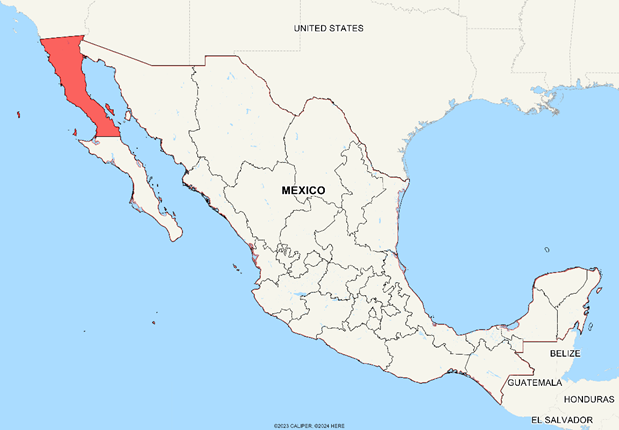
As with many of the Mexican border states, Baja California Norte is a relatively affluent state, with average household income 25% higher than the national average. Since the NAFTA (North American Free Trade Agreement), the population has more than doubled, most of it in Tijuana and Mexicali. Since 2020, however, the state population has been unchanged and manufacturing growth has all but stopped. The backbone of the economy are the maquiladora factories where raw materials are imported into Mexico duty-free, and the finished products are immediately exported to markets in the US and Canada.
Tijuana at the turn of the 20th century was nothing but a large rancho which happened to sit on the US-Mexican border. Its first growth period was entirely due to external events – the declaration of Prohibition in the United States. A small village grew into a resort town with its hotels, beaches, and most importantly, taverns. Having discovered the Mexican coast, Californians have continued to make tourism a substantial component of the economy. Since the industrialization of the 1960’s, Tijuana has been one of the fastest growing cities in North America and now has well over two million residents.
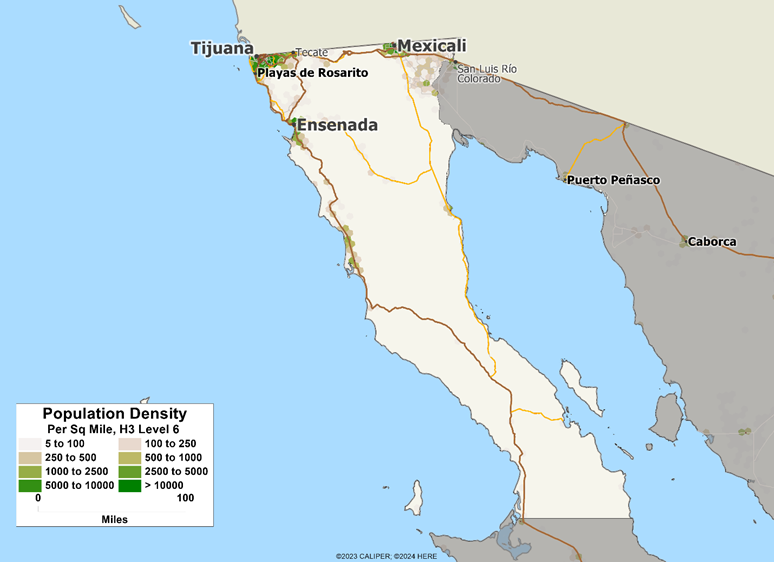
Finally, the growing wine district of Valle de Guadalupe, northeast of Ensenada, produces nearly three quarters of Mexico’s wine, much of it exported to the north.
The main historical impediments to settlement are freshwater and terrain, and on the gulf side, a lack of natural harbors. As such, this area remains among the least populated in Mexico. Most of the villages date to the founding of the mission system which stretched from Las Cabos north to the San Francisco area. The missions were generally about 30 miles apart and linked by the El Camino Real trails. Until the completion of Mexico Highway 1 in the early 1970’s, the remnants of those trails were often the only land connection available.
The continued growth of the border cities is largely dependent upon the availability of water and the continuation of the free trade agreement with the United States. While labor costs relative to competitive regions in southeast Asia, the proximity of the border cities to the US market remain its greatest strength. The impediments to growth remain as they always have – water and terrain – but with the added burden of a growing cartel crime problem.