
Last week, Target announced that it had identified “busy families” as their target market (no pun intended). My first thought was utter confusion. For a company literally named Target, identifying the target customer seems like something that should have happened sometime around 1962 when they were founded. Perhaps a lack of clarity around this basic element of their business model is partly to blame for some of their recent shortcomings. Will this new focus be able to turn around this popular retailer?
Target has an astonishing number of stores, located in all 50 states. Over the years, they have tried a variety of different store “formats”, from small format stores called “CityTarget” and “TargetExpress” to the standard suburban “SuperTarget”. To start, we asked the team at Sites USA to pull the list of Target stores for us from their POI data. The map below shows just how many Target stores are in each state. The distribution isn’t random. Target stores tend to cluster in suburban areas with strong concentrations of households with children and above-average incomes—exactly the demographic profile the company now says it wants to prioritize.
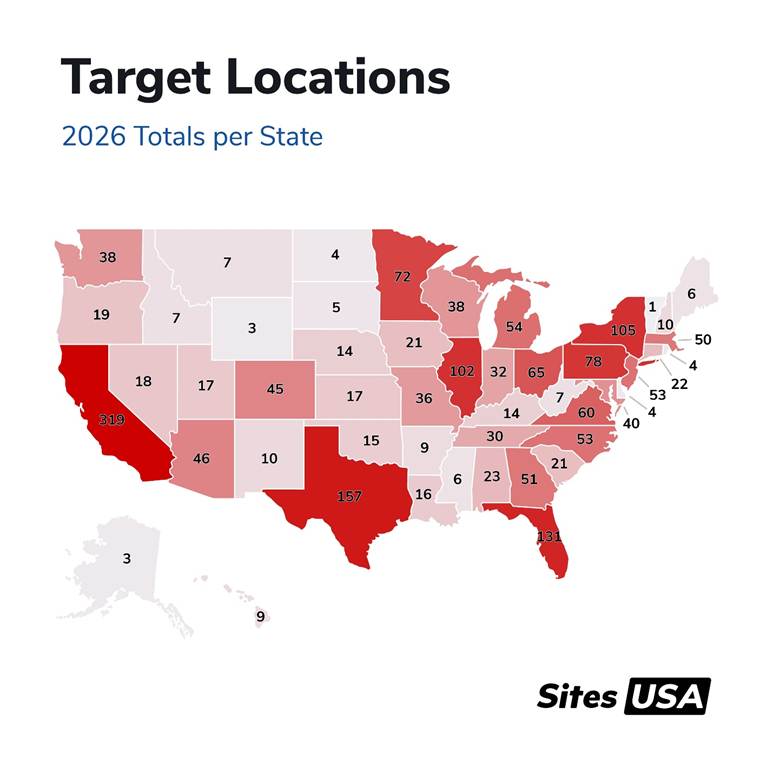
Walk into any business in your city and ask the owner who their shopper is, and they will certainly be able to tell you the basic demographics, even if that isn’t exactly what you asked. At the bare minimum, they will say something like “women, age 30-40 with kids at home” or “men aged 65+ looking for a healthier lifestyle”. One might argue that the Target shopper is about 40 years old, female, with kids at home making just above average incomes. And that isn’t me arguing it, that’s on Target’s Wikipedia page. Which begs the question: haven’t they known their target market all along?
It’s no secret that Target has faced several high-profile challenges over the past decade. The company’s expansion into Canada—where it opened more than 100 stores by taking over former Zellers locations—ended abruptly when all stores closed just two years later. More recently, the company has faced boycotts from both sides of the political spectrum over various corporate decisions.
If you are a retailer, you know how important it is to understand your customers and cater to them and why they come to your shop. Identifying a retailer’s core shopper is something that can be measured easily with demographic data. Household composition, age cohorts, income levels, and consumer spending patterns all paint a clear picture of your customers and where they live. Retailers have been using this information for decades to determine where to place stores and what products to stock. If “busy families” are indeed the focus, the question becomes where those households are located and how they shop.
So, what is their plan with their new knowledge of their target demographics? They will be investing in the baby, kids and grocery sections of stores, as well as prioritizing the order pickup and same day delivery services. Sure, this fits busy families. But didn’t it fit their last target demographic as well? Because newsflash: it hasn’t changed.
In truth, Target probably hasn’t suddenly discovered a new customer. “Busy families” have likely been their core shopper all along. The real question is whether the company will refocus its stores, merchandise mix, and locations around that reality. For retailers, understanding your customer isn’t just good marketing—it’s the foundation of everything from site selection to product assortment. And in that respect, the most surprising part of Target’s announcement may simply be that it took this long to say it out loud.