
For years, demographic and segmentation data has helped businesses understand who their customers are and where they live. But in many industries, what matters just as much is where people go every day. Where do they work? Where do they spend their lunch hour? Where do they shop, dine, and run errands between meetings?
To help answer these questions, we are excited to introduce Panorama Workplace—a new database that brings our Panorama segmentation into the workplace environment.
Panorama Workplace is built using the 2023 Longitudinal Employer-Household Dynamics (LODES) journey-to-work data, analyzed at the census block level. This allows us to examine commuting patterns with remarkable geographic precision. We then apply our native Panorama segmentation to this data, shifting the focus from where people live to where they work. Instead of viewing segments only in residential neighborhoods, Panorama Workplace shows how different consumer groups are distributed across employment centers, downtowns, office parks, and commercial corridors. The result is a powerful new lens on daytime populations and workforce geography.
Few metropolitan areas illustrate the value of this approach better than New York. New York remains the classic downtown-centric city. Each day, millions of workers commute from inner and outer suburbs into Manhattan, especially Lower Manhattan and Midtown. While this general pattern is well known, Panorama Workplace reveals how different lifestyle and income segments participate in this flow.
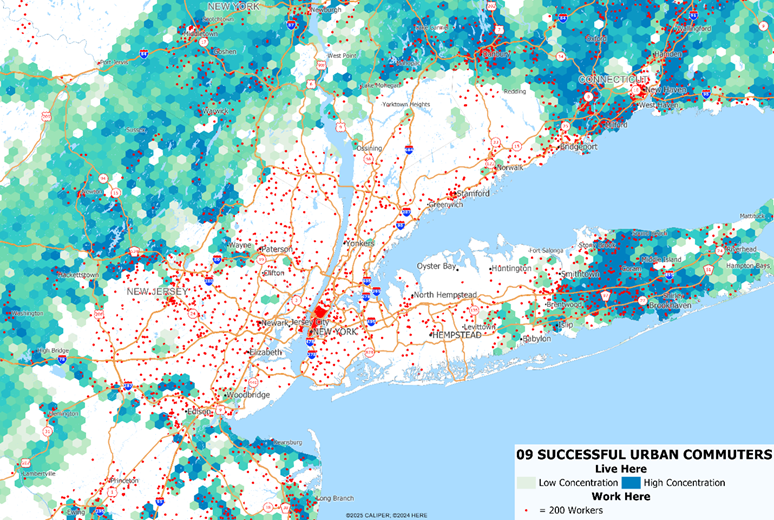
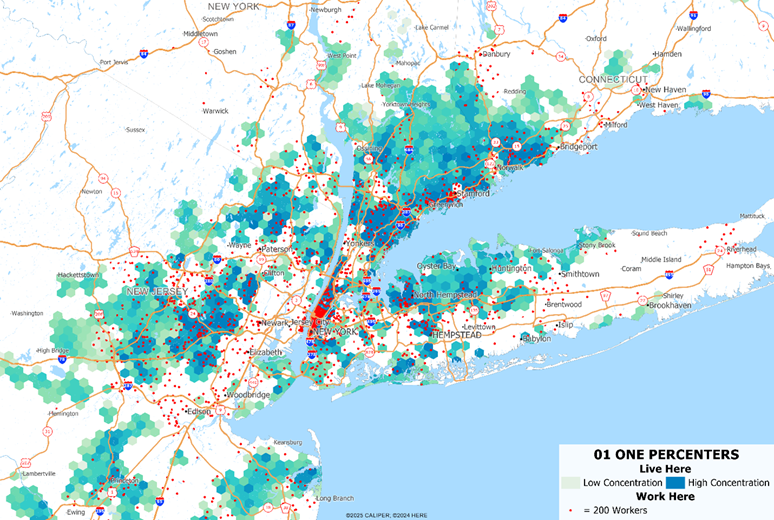
The accompanying maps highlight four Panorama segments, showing both where they live and where they work:
- Segment 09 – Successful Urban Commuters
This group tends to live near the outer edges of the metropolitan area and commute long distances into Manhattan. Their daily routines are often tightly scheduled, and they are more likely to leave promptly at the end of the workday.
- Segment 01 – One Percenters
These households generally live closer to the urban core, balancing proximity to employment with premium residential locations. Their commuting patterns are shorter and more flexible.
- Segment 26 – High Density Diversity
This segment is heavily concentrated within the five boroughs. Many live close to where they work and are deeply embedded in the city’s neighborhoods.
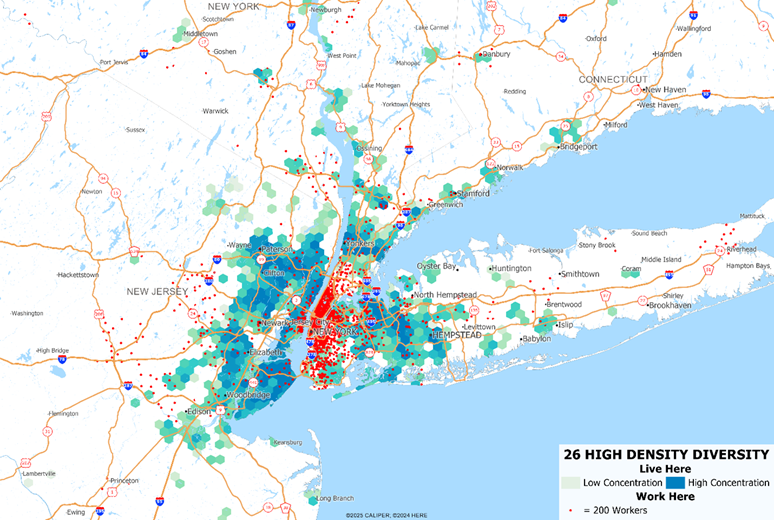
Despite differences in where they live, all three groups show strong convergence in Lower Manhattan. The workplace remains a common destination, even as residential patterns vary. What makes this especially interesting is how these patterns influence behavior. Segment 09 workers are more likely to head straight home after work. Segment 26 workers, on the other hand, are more likely to stay in the area—meeting friends, dining out, or shopping locally. These differences have real implications for downtown businesses.
Panorama Workplace also highlights segments that behave very differently. Segment 30, Urban Black Neighborhoods, for example, tends to work very near home and is highly concentrated in just a few parts of the city. Rather than participating in long-distance commuting, these workers remain embedded in local employment hubs. Their spending patterns, travel habits, and daily routines look very different from those of Manhattan-bound commuters.
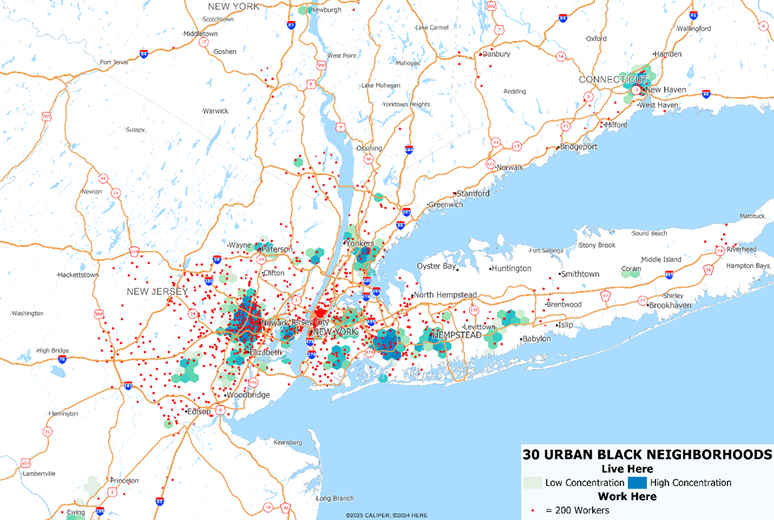
By comparing these groups, users can quickly see which areas attract regional workers and which serve primarily local populations.
Panorama Workplace is built at national scale and depth:
- Based on our 68 residential Panorama segments
- Covers approximately 145 million journey-to-work flows for 2023
- Uses census block–level geography for detailed spatial analysis
- Integrates seamlessly with existing Panorama products
This combination allows users to analyze not just where workers come from, but who they are and how they are likely to behave during the day. Panorama Workplace is a valuable addition to our data toolkit—especially for organizations that depend on daytime populations. Restaurants, cafés, and food service providers can better understand lunch and after-work demand. Retailers can identify corridors where daytime foot traffic differs sharply from residential patterns. Real estate developers and site selectors can evaluate the true economic activity of employment districts. Financial institutions and planners can assess how workforce flows shape local markets.
By connecting lifestyle segmentation with workplace geography, Panorama Workplace provides a clearer picture of how cities function between 9 a.m. and 5 p.m. We are excited to bring this new perspective to our clients and partners—and to help businesses make smarter, more informed decisions based on where America works.