
When you think “Spring Break”, you likely think about rowdy college students on the beach in Florida praying for good weather and free beers. While it certainly can mean college students piling into nightlife-heavy beach towns, it is also families looking for a warm-weather escape while school is out, or groups simply chasing sunshine somewhere drivable. That matters, because the Florida Gulf Coast is often lumped into the same conversation as Florida’s more notorious party destinations, even though the actual traveler mix can look very different from place to place. Recent reporting suggests the story in 2026 is not just about crowds, but about who those crowds are and how destinations are trying to shape them. Florida remains one of the biggest spring break draws in the country, and AAA says many travelers are still choosing Florida for beach trips and cruises, while many families are booking Caribbean sailings out of Florida during the school break window.
On paper, a quarterly non-resident or leisure tourist average can make spring break look almost modest. One or two extremely busy weeks get diluted when spread across an entire first quarter. A place can experience a true surge in March and still look merely busy rather than overwhelmed on a Q1 density map. In our Non-Resident Population maps of the Gulf Coast, the tourist pattern does appear where you would expect it: strung tightly along the beach communities, with the strongest concentrations hugging the shoreline rather than spreading far inland. But the better story may not be whether the Gulf Coast “wins” on a quarterly map. It may be that some spring break destinations experience such sharp, compressed bursts of visitors that quarterly averages almost hide the real-world intensity.
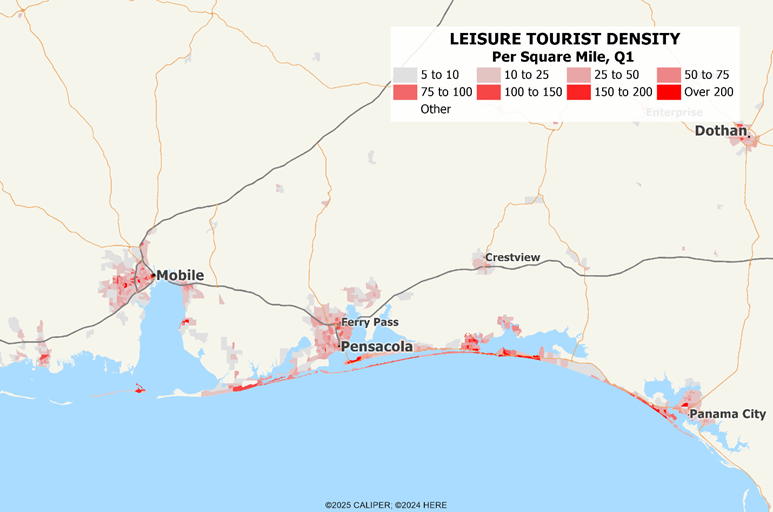
Recent local coverage out of the Panhandle supports the idea that the Gulf Coast is serving more than one spring break audience at once. In Panama City Beach, officials approved stricter spring break rules aimed at underage visitors after police said high-school-aged visitors caused many of last year’s problems. Police also said they used prior spring break data to identify high-impact zones for extra enforcement. At the same time, local coverage this month described volunteer shuttle programs specifically serving college students in Panama City Beach during spring break nights, a reminder that the classic student market has not disappeared. Just down the coast, Seaside is again enforcing a 7 p.m. curfew for unaccompanied minors, with local leaders explicitly saying the goal is to preserve a family-friendly atmosphere.
That mix is probably the real Gulf Coast story: these are not purely college destinations, but neither are they purely family destinations. They are negotiated destinations. Communities are actively deciding which travelers they want more of and which behaviors they want less of. The crackdown itself is part of the market signal.
That also helps explain why Daytona may be the more dramatic comparison point. Daytona Beach is openly marketing a “Spring Family Beach Break,” emphasizing multigenerational family travel, attractions, cheer and dance championships, and a broad range of lodging options. The city’s tourism messaging is clearly aimed at families, not just students. But at the same time, Daytona is dealing with the other extreme. This week, local and national reporting described large, unsanctioned spring break gatherings, more than 130 arrests in Volusia County over the weekend, and multiple shootings tied to the crowds. Local officials said they had prepared for heavy visitation with extra law enforcement and a zero-tolerance posture.
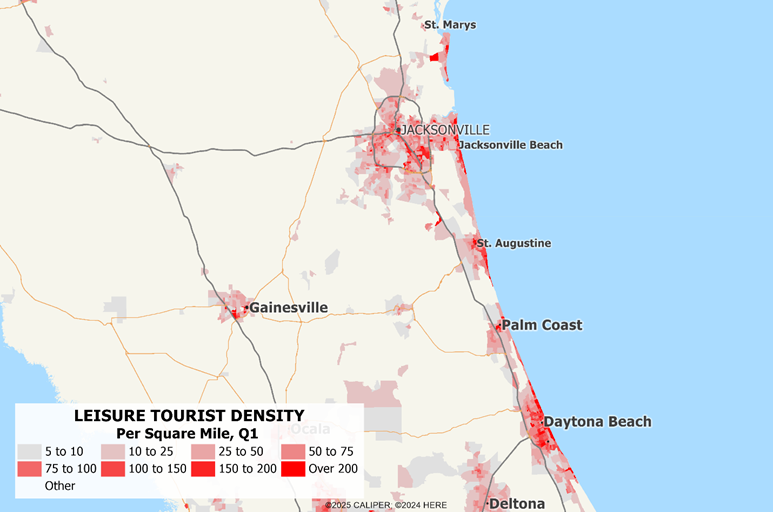
That tension makes for a stronger story than a simple “where are tourists going?” post. The question is not just where Q1 tourists show up on a map. It is what kind of spring break economy each destination is trying to build. Daytona’s density map looks intense because the tourist concentration is packed tightly along a long beachfront corridor. Maps of Myrtle Beach and the Florida Keys show a similar effect: strong coastal concentrations, but each with a different brand and traveler expectation. The Gulf Coast, by contrast, reads more fragmented. Pensacola, Panama City Beach, and the surrounding shore communities all light up, but as a series of nodes rather than one singular strip. That may reflect a region where spring break demand is substantial yet split across several submarkets with different identities.
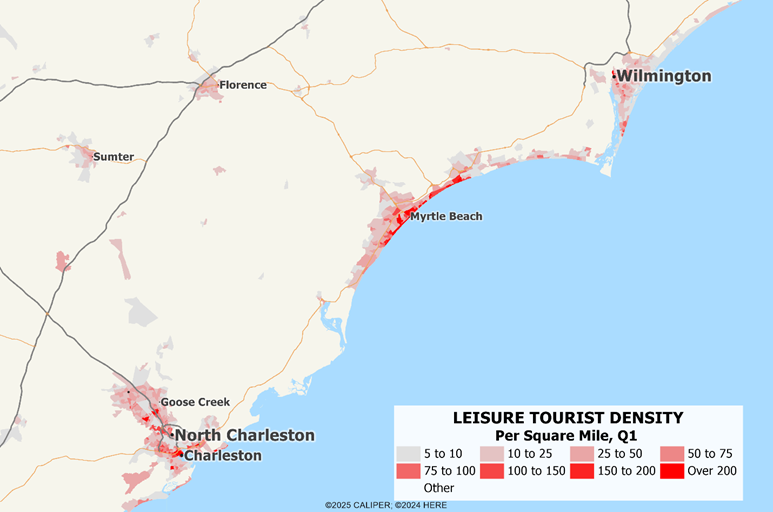
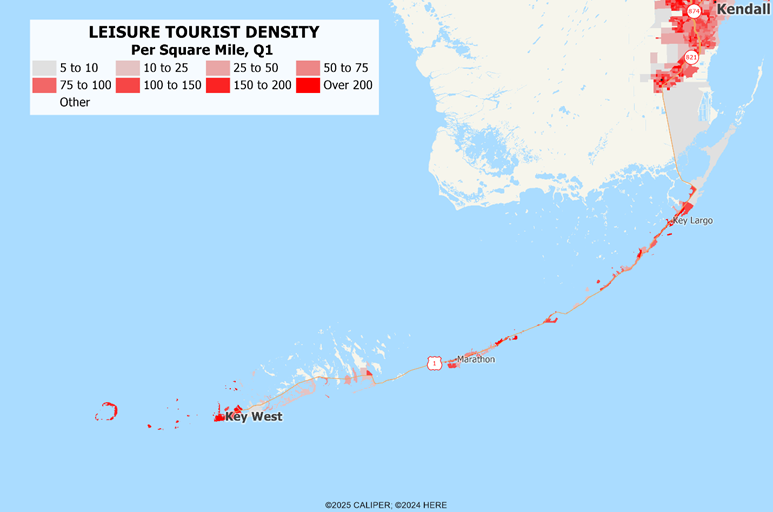
In other words, spring break is not one market, and Florida is not one spring break story. Some places are still managing the legacy of the college-party era. Some are repositioning toward families. Some are trying to do both. And if you rely only on a quarterly tourist map, you can miss the fact that a destination’s most important week may be buried inside an average.
The real value of non-resident and tourist data is not always in showing a giant red blob on a map. Sometimes it is in reminding us that timing matters. A one-week flood of visitors can reshape traffic, policing, retail demand, and beach activity even when the quarterly average looks manageable. Spring break is a perfect example: short, intense, highly seasonal, and very different depending on whether your visitors are college students, high-school groups, or families with kids in tow.