
In the last few years, there has been a broadening awareness about the emerging housing crisis in Canada. Housing prices skyrocketed over the last decade while new construction lagged, especially of single-family dwellings. More recently, after the publishing of the latest GDP estimates, alarms have been sounding about the economy in general and the standard of living in the country.
The performance of the Canadian economy has always been closely tied to that of the United States. The auto industry was at the heart of the integration of the two economies which fueled the economy on both sides of the Great Lakes. In the 1960’s, the greatest concern in Canada was related to the ‘brain drain’, which was the persistent emigration of highly educated Canadians to the United States. But decades of uncertainty about the future of the Canadian confederation resulting from separatist sentiment in Quebec and a growing level of economic intervention by governments seem to have changed that balance.
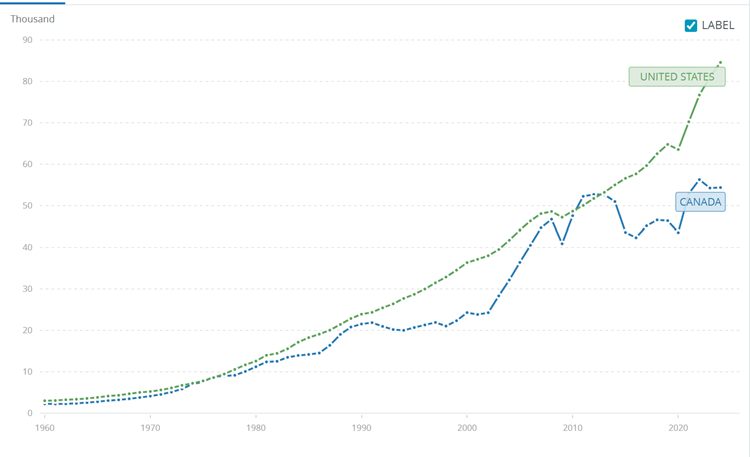
The chart below, from the World Bank, shows that something fundamentally changed after about 2010, when per capita income (in current USD) has effectively been flat. Both countries suffered a slowdown during the COVID years, but national productivity declined well before then, from nearly $51,000 per capita in 2014 to $42,315 in 2016. While incomes had a post-COVID increase, incomes have once again declined:
| 2022 | 2024 | % Change | |
| Canada | $56,257 | $54,340 | -3.4% |
| United States | $76,657 | $84,534 | + 10.3% |
Per capita GDP in Canada was actually higher than in the United States just fifteen years ago, after rising substantially during the 2000-2010 period.
So, what is happening?
Since 2006, the population of Canada has increased by 30%, nearly double the increase in the United States. Most of that growth has come from international immigration. At the same time as the federal government was allowing massive immigration, they simultaneously pursued aggressive climate policies and implemented a wide range of anti-development policies.
The Fraser Institute, a long established conservative think-tank, recently published a paper “Canada’s ‘Ugly’ Growth Experience, 2020-2024” (https://www.fraserinstitute.org/sites/default/files/2025-09/canadas-ugly-growth-experience-2020-2024_0.pdf) which cites two main factors –
- Weak growth in business investment
- Unprecedented levels of immigration
Many companies with locations on both sides of the border simply did not reinvest in their Canadian operations because of the higher regulatory burden, significantly higher taxes, and the lowering of labor costs because of the massive increase in the labor force population.
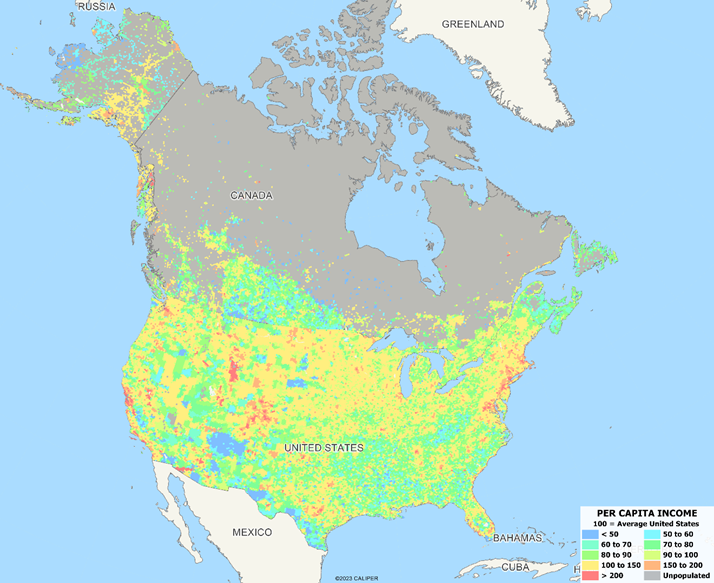
The economic engine of southern Ontario appears to have simply stalled out, and what was once one of the most prosperous regions of North America now lags behind the ‘rust belt’ states of New York, Ohio, and Michigan. The map below shows per capita income with a value of 100 being the US average.
At the same time, the lack of new housing to accommodate the massive increase in population has resulted in even larger increases in housing costs amid calls for government intervention. We note, however, that it was such intervention that largely resulted in the problem in the first place, and the Fraser Institute paper ends with a pessimistic note:
“The outlook for growth in living standards in Canada over the medium term is bleak and dramatic changes in policies, particularly in Ottawa, are required to reverse the country’s markedly poor economic performance.”
Ottawa is getting more chummy with China and is likely to exacerbate rather than alleviate its largely self-inflicted difficulties in an era where the United States has adopted a strong ‘America first’ stance. The government has drastically cut back its targets for inbound migration, but at the same time is increasing spending which will eventually result in a yet higher tax burden.
While we hope the Fraser Institute is dead wrong in their assessment, we see nothing coming out of Ottawa that would change their assessment.