
California has a housing problem. The housing stock has simply not kept up with the growth of the population, especially over the last few decades. The state’s housing prices are legendary – a modest house in a so-so neighborhood can run you a million dollars, more if you don’t have to park on the street. The same million dollars can buy a house at least twice the size, with a three-car garage, in upscale neighborhoods in most midwestern cities.
In the major urban areas of the coast, the cities are wedged between the ocean and the mountains and have little developable land remaining. Such land is pricey, and then you have to run the gauntlet of agencies from the city or county to the Coastal Commission. Every one of them demands payment of fees that can easily add $200,000 to the price of a new home, adding to the unaffordability.
Over the past several years, the state Legislature has passed several bills aimed at lessening the problem. Local governments, with few exceptions, must quickly approve ADU (Accessory Dwelling Unit) permit applications and have worked to lessen the permit cost on builders and to remove most of the rules which would otherwise apply. Every year or so, the state sweetens the pot by removing yet more barriers.
With that in mind, we thought we would take a look and see how this is working out. One of the data sources for our demographic estimates and projections is AI-enhanced permit data from most jurisdictions nationwide that we get monthly from Shovels (www.shovels.ai). We looked at the total number of ADU permits issued by census block since 2020, and the results are quite interesting.
In Los Angeles County alone, over 115,000 permits related to ADU construction have been filed. Some projects are abandoned, and others are repeat permits for the same ADU, but nevertheless, we would expect that about 50,000 ADU’s have been constructed in the county in just five years.
But where are these ADU permits being issued? The map below shows a count by census block:
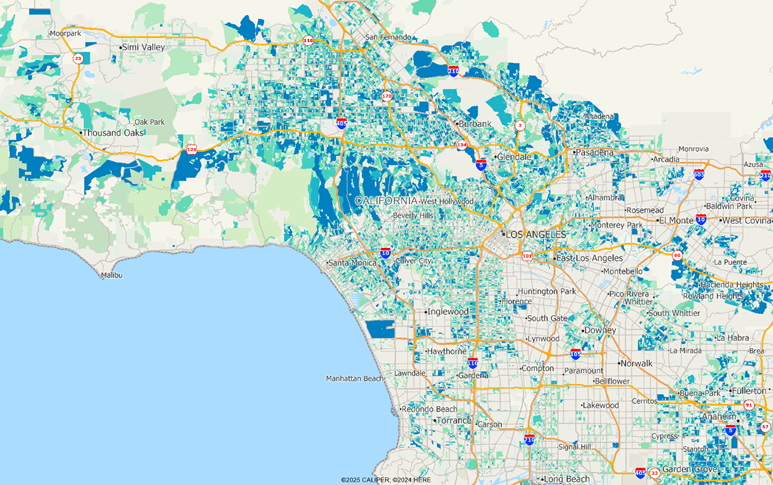
The Shovels database is a work in progress and many of the smaller jurisdictions have not yet been added. Every month the coverage of the file improves. Despite these gaps, and despite state laws to the contrary, it is clear that some jurisdictions are not as excited about ADU’s as others.
The pattern of permits is striking – there is a clear tendency here for more affluent areas to have more permit applications. There are three areas where permit activity is very high – along the Ventura Boulevard/US 101 corridor through the San Fernando Valley to Thousand Oaks, along the 210 freeway from Glendale to Pasadena, and in the legendary canyons of the Hollywood Hills. All affluent areas, but there is more here than just having the cash needed to build the ADU – you must have enough land to build a second house on it.
While these laws are having the desired effect in many areas of the city, we find it interesting how many simply aren’t helping the overall problem. Many are being built as guest houses for visiting friends and family, rented as vacation homes, or where the 27 year old son lives independently of mom and dad. Those that are rented out? That 600 square foot unit off Benedict Canyon will run a good $5000/month. Affordable? Not so much. Clearly, not enough ADU’s are being built in the areas of town where they are really needed.
Governments seem to recognize this, as the ADU rules are being changed almost yearly – in each case broadening the number of properties that might qualify. Some of those changes have included allowing the ADU to be sold as a condo type unit, not requiring the property owner to live on the property, having separate utility billing, removing lot line setback requirements, drastically lowering permit fees, and even dropping the parking requirement.
Is it working? Given the annual legislative efforts, not as well as hoped. In a metropolitan area of this size, adding even 10,000 ADU’s a year is just a drop in the bucket. More needs to be done to keep up with population and the need for affordable housing.