
With the mid-term elections coming up in the United States, an Alberta independence referendum on the horizon, and some fresh Canadian data, we thought we would look at the electoral systems of Canada, the United States, and Mexico.
Specifically, depending on where you live, how much weight does your vote have in an election?
We used the latest federal electoral district boundaries, ignoring for present purposes the major shifts in some American states as we head into the mid-term elections. We only consider the “lower” house of each country, each of which are elected from geographically defined districts and avoided state-wide systems such as the US senate.
| Canada | Mexico | United States | |
| # Representatives | 343 | 300 | 435 |
| Average Population | 120,909 | 344,875 | 784,939 |
| Standard Deviation | 22,125 | 105,161 | 53,887 |
| Average Deviation | 8.8% | 25.9% | 4.7% |
| Maximum Deviation | 76.6% | 80.2% | 34.8% |
Of the three systems, the United States has the most balanced sized districts, with an average deviation of under 5%. Mexico has the greatest variability, with very few districts actually near the average.
In large part, the deviation in sizes is strongly related to the relative sizes of states and provinces. In Canada, Prince Edward Island is guaranteed 4 seats in the House of Commons, despite having a total population of just over 180,000. The result is that a voter in Charlottetown has a much greater weight than a similar voter in Calgary Centre, which has nearly as many people as does the entire province of PEI.
In order to compare across countries – where the average population size is radically different, we computed the deviation from the mean population and expressed it as a percentage of that mean.
So where does your vote count the most or the least in each country?
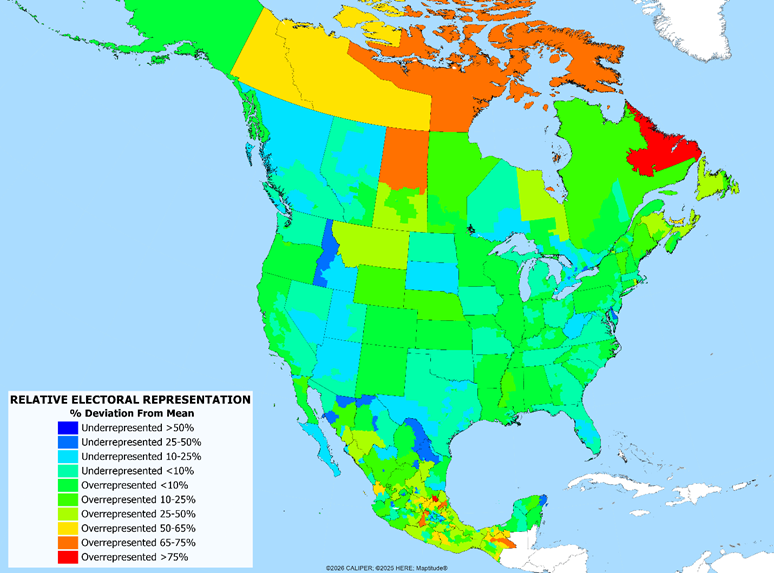
Comparing between countries, the most over and underrepresented districts are:
| Overrepresented % | Underrepresented % | |
| Canada | Labrador (76.6%) | Calgary Centre (29.9%) |
| Mexico | San Luis Potosi 292 (80.2%) | Nuevo Leon 190 (55.5%) |
| United States | Rhode Island 1 (29.3%) | Delaware 1 (34.9%) |
There are some overall patterns –
- The allocation of districts by state or province is the primary distorting factor, as smaller areas tend to be overrepresented
- Areas with recent growth, as well as the suburban areas of major cities tend to be underrepresented
If you want your vote to count the most, move to Tamazunchale in the southwest corner of San Luis Potosi. Failing that, move to Labrador, the least populated electoral district on the continent. Sure, the weather is not exactly appealing to most and flight connections are horrible, but with only 28,280 people, your vote will surely be the deciding one. Also, if you are willing to work in the iron ore mines of Labrador City, you will make lots of money, giving you opportunity to finance the candidate of your choice.