
Every Super Bowl season, the same assumptions take the field. Big cities have bigger budgets. Bigger fan bases. Bigger egos. Surely that must translate into more Lombardi Trophies… right? It turns out, that’s not exactly how it works. Thanks to the NFL’s salary cap (introduced in 1994), teams now have an equalizer when it comes to players. That makes the Super Bowl a perfect excuse to ask a question that feels obvious, but turns out to be anything but: Does market size matter when it comes to winning?
When anyone close to the NFL talks about “market size”, they are usually referring to the amount of TV audience any team pulls in. As a demographic and geographic based company, we decided to group teams our way. So, we paired every Super Bowl winner in the salary-cap era with the nearest decennial Census metropolitan population at the time of their win. Markets were then grouped into five tiers based on market size, everything from Green Bay up to NYC.
Here’s where things get interesting. Nearly half of all Super Bowls since 1994 were won by teams from mid-sized metros (2–3.5 million people). These aren’t the league’s biggest markets—and they certainly aren’t the smallest—but they show up on championship Sunday far more often than anyone might expect.
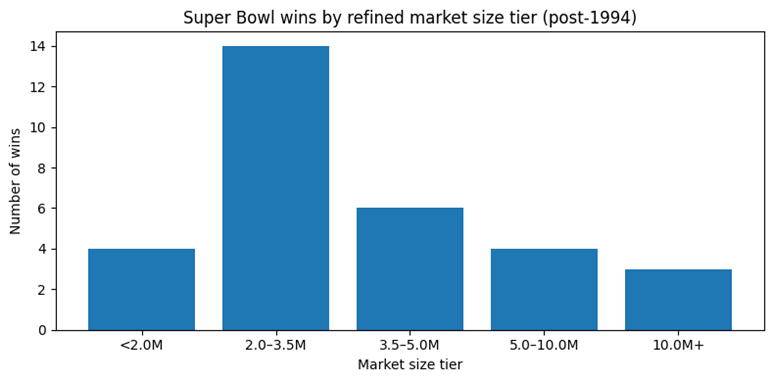
Mega markets (10+ million people) have a shockingly low amount of Lombardi trophies in the last 20 years, just two from the New York Giants and one from the Los Angeles Rams after they made the move from St. Louis. For all their media glare and celebrity sightings, they’ve been about as dominant in the Super Bowl as the phrase “this is our year.” Small markets do break through occasionally and have even won more often than these mega markets, but they’re not the main story here. If anything, the data suggests there’s a Goldilocks zone of football success: big enough to support infrastructure and talent, small enough to avoid constant chaos.
But does this translate to the regular season? The second chart zooms out to the regular season, plotting winning percentage by market size since 1994. The result? A beautiful mess.
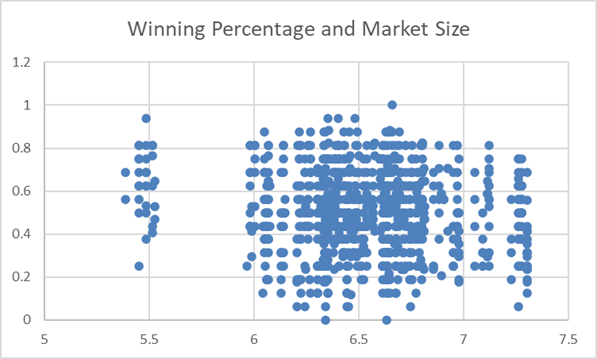
Winning teams exist everywhere. Losing teams exist everywhere. Market size does not politely line up and explain itself. Instead, you get a wide scatter of outcomes across all population tiers—proof that Sunday wins are handed out far more randomly. In other words, big markets don’t win more games just because they’re big, and small markets aren’t doomed to eternal rebuilds. Competence travels well.
The NFL is unusual. There’s a hard salary cap, revenue is shared, and draft picks favor struggling teams. And thanks to national TV deals, a win in Kansas City gets just as much airtime as a win in New York—no matter how many people live in that metro area.
If market size isn’t the secret weapon, what is? Boring things. Stability. Good decisions. Solid coaching. Not panicking every three years.
The NFL’s modern history suggests that organizational competence beats city size every time. Mid-sized markets have quietly turned that formula into championships—while bigger cities occasionally try to buy the shortcut and learn (again) that it doesn’t exist.
So as Super Bowl Sunday approaches, remember: the Lombardi Trophy doesn’t care how many people live nearby. It only cares whether the team holding it did the work.
And maybe had a really good quarterback.