
Five years ago, we partnered with Gary Warkentine (whom we lovingly refer to as “Manitoba Gary,” so as not to confuse our two Garys) of Exceed Analysis (http://exceedanalysis.com) to expand the AGS product line into Canada. Since then, many of our software and consulting partners have adopted these estimates, and we have continued investing in expanding the breadth and depth of Canadian content, which now includes:
- Demographic Estimates and Projections
- Consumer Expenditures
- Household Finances
- Panorama CanAm
- Dimensions Canada
- Crime Risk Canada
- Business Counts Canada
We’re kicking off 2026 with a small but significant addition: comprehensive daytime population estimates. This new dataset is based on special tabulations from Statistics Canada that capture where people live as well as where they work. Daytime population estimates are provided in considerable detail, recognizing that retail behavior and service demand can vary substantially throughout the day. The data separately tracks workers who work at home, those who work at a fixed place of business, and workers with no specified regular location.
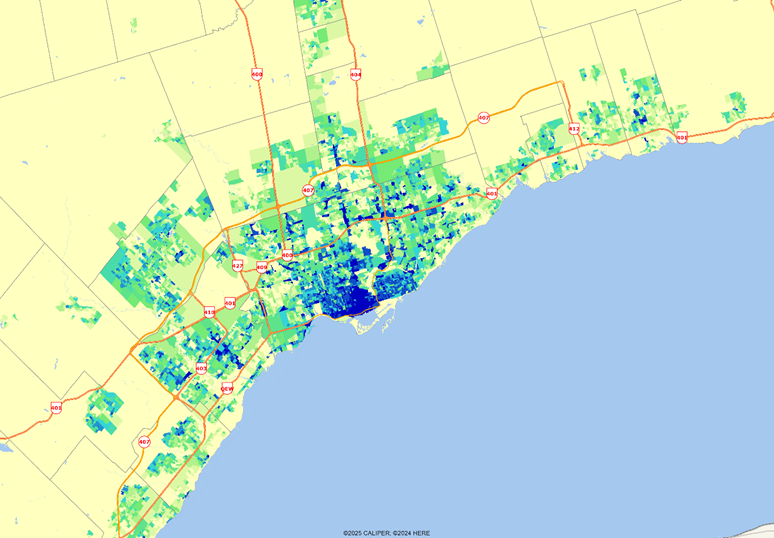
Toronto, long recognized as a central business district and public transit–oriented city, continues to be dominated by downtown employment. Over time, major employment concentrations have developed along subway corridors that feed the downtown core, as well as along most major freeway routes.
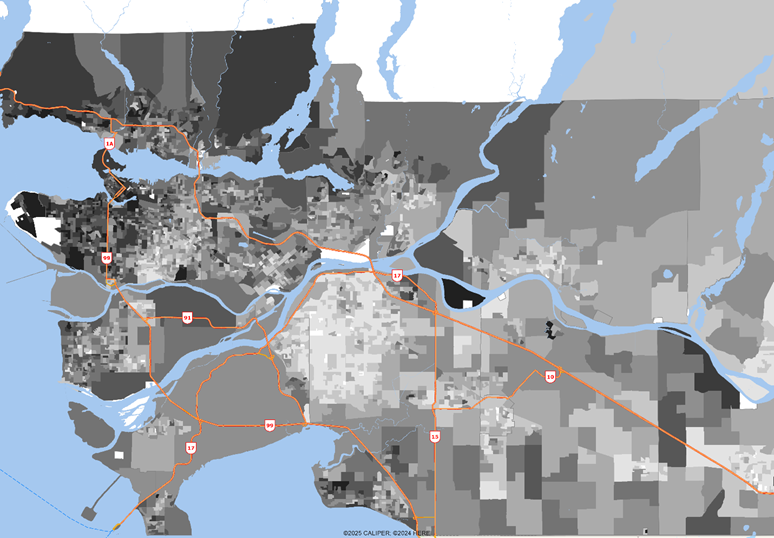
As in the United States, a growing share of Canada’s workforce now avoids the daily commute and works from home. Work-from-home rates tend to be highest in more affluent neighborhoods—such as many areas of Vancouver—and lower in less affluent, working-class communities.
In addition to detailed daytime population counts, the dataset also includes estimates for:
- Income by source (government transfers, employment income, and other income)
- Daytime per capita income
- Occupation by place of work
- Industry by place of work
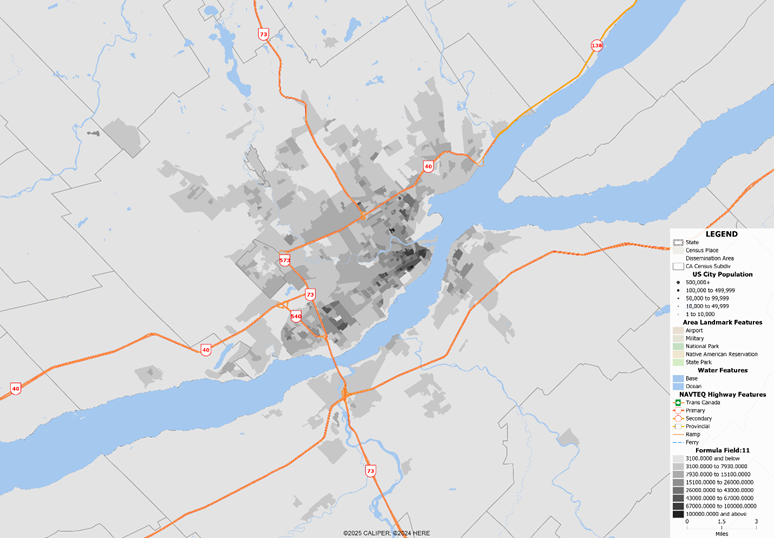
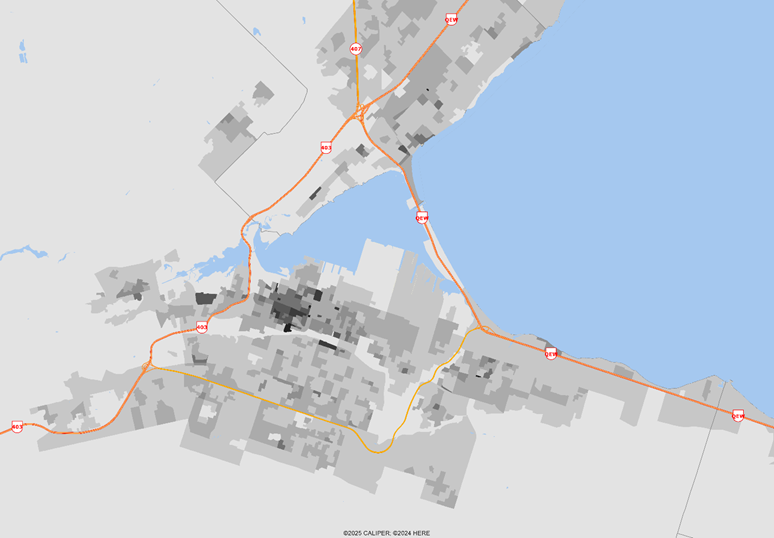
The two maps below illustrate daytime population patterns in Hamilton, Ontario and Québec City.
Data for Canada is available across a wide range of geographic levels, including Dissemination Areas (block-group equivalent), census and administrative areas, postal areas, and hexagon levels 3 through 7. While the dataset is available now, it will be formally included in the 2026 release as part of the AGS Premium Data product for Canada.