
As the United States prepares to host the 2026 FIFA World Cup alongside Canada and Mexico, the tournament is creating renewed attention around soccer’s place in the American sports landscape. While soccer still trails football, baseball, and basketball in popularity nationally, the geography of World Cup fandom tells a more interesting story. The strongest concentrations of soccer enthusiasm are not evenly spread across the country — instead, they cluster heavily in large metropolitan areas, multicultural regions, and many of the same cities chosen to host the tournament itself.
Using Panorama consumer segmentation data, we examined where Americans identify as World Cup “superfans” and how those patterns compare to the selected U.S. host cities. The results suggest FIFA and local organizers may have picked locations that already align closely with America’s strongest soccer markets.
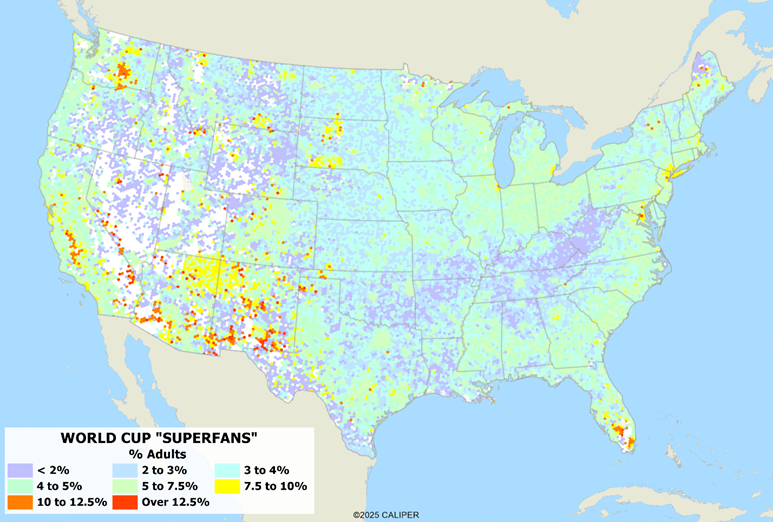
At a national level, soccer still sits below the traditional American sports hierarchy. About 31.1% of adults express at least some interest in international soccer, while only 5.7% qualify as superfans. MLS ranks even lower, with 27.9% reporting any interest and just 3.1% considered superfans. Compare that to the NFL, where 58.4% of adults report interest and more than one in five adults qualify as superfans. College football, Major League Baseball, and the NBA all outperform soccer nationally in both overall interest and fan intensity.
Still, soccer fandom behaves very differently geographically than many other American sports.
The map of World Cup superfans reveals strong concentrations across South Florida, Southern California, Arizona, Texas, the Northeast Corridor, and several Pacific Northwest metros. These patterns align closely with younger populations, urban density, and Hispanic communities — demographics that consistently over-index for soccer interest in Panorama segmentation data.
Many of the 2026 host cities fall directly within these high-interest corridors.
Miami stands out immediately. South Florida contains some of the highest concentrations of World Cup superfans anywhere in the country, reflecting both its large Hispanic population and its strong international ties to Latin America and the Caribbean. Los Angeles shows a similar pattern, with extensive clusters of high-interest grids stretching across Southern California. The region’s diversity, immigrant communities, and long-standing soccer culture make it one of the nation’s most naturally aligned World Cup markets.
The Texas host cities also compare favorably to the map. Dallas and Houston sit within broad areas of elevated soccer enthusiasm, particularly among younger suburban and Hispanic populations. Houston in particular benefits from its diverse population mix and strong ties to soccer-heavy countries across Latin America. Even though football still dominates culturally in Texas, the state’s rapid demographic change has created some of the country’s largest concentrations of soccer supporters.
The Northeast host cities tell another interesting story. New York and nearby northern New Jersey show dense pockets of superfans, especially in urban neighborhoods and inner-ring suburbs. Philadelphia and Boston also contain notable concentrations, although they are somewhat less intense than Miami or Los Angeles. These older metropolitan regions combine density, immigration, and international connectivity in ways that support stronger soccer engagement than many smaller interior markets.
Seattle may be the most unique case among the host cities. Unlike many of the Southwest and Florida markets, its soccer culture is less tied to Hispanic demographics and more connected to long-standing local enthusiasm for the sport itself. Seattle and Portland have spent years cultivating some of MLS’s most passionate fan bases, and the map reflects that sustained interest. In many ways, soccer in the Pacific Northwest resembles the regional identity attachment seen with college football in the Southeast.
Not every host city sits inside a major superfan hotspot, however. Kansas City and Atlanta show more moderate levels of interest overall, yet these locations still offer strong infrastructure, central geography, and growing youth soccer participation. FIFA’s site selection appears to balance existing fandom with stadium capacity, transportation access, and broader national representation.
One of the more fascinating findings from the Panorama data involves affluent consumers. Segment 01 “One Percenters” reports relatively high levels of general soccer interest, but a lower-than-expected percentage of superfans. In other words, wealthy professionals are likely to watch marquee matches or follow the World Cup casually, but they are less likely to display the deep emotional engagement seen among younger audiences. Soccer in the United States increasingly appears to be culturally visible across income groups, even if its most passionate fan bases remain concentrated elsewhere.
The broader sports landscape also provides important context. Less than 10% of Americans say they have no interest in any sport at all, while more than 92% express interest in at least one sport. Roughly 7.3% of adults qualify as sports superfans in some category. Soccer’s challenge is not introducing Americans to sports fandom — it is competing against deeply entrenched sports loyalties that already dominate many regional markets.
That may also explain why international soccer performs significantly better than MLS in the data. The World Cup functions more like the Olympics than a traditional league season. Casual fans who may never watch MLS throughout the year often tune in for international competition, national pride, and the spectacle of a global tournament. The event temporarily expands soccer’s reach beyond its traditional fan base.
The geography of World Cup superfans ultimately offers a preview of broader demographic change across the United States. The strongest soccer markets tend to be younger, more urban, more diverse, and more globally connected than the country as a whole. Many of the host cities selected for 2026 already reflect those trends, which helps explain why the tournament feels particularly well-positioned for this moment in American demographics.
The United States may still be an NFL-first country, but the map suggests soccer’s future growth is already taking shape in the nation’s largest and fastest-changing metros. As the World Cup approaches, those geographic patterns may become even harder to ignore.