
For generations, children (and many adults) have believed Santa’s workshop sits squarely at the North Pole. But as Santa’s newly appointed site selection consultants, we can confidently say: that assumption has been causing serious logistics issues.
Contrary to popular belief, Santa’s original workshop was never located at the true North Pole. Because reindeer navigation relies on magnetic fields, the workshop was historically positioned at the magnetic North Pole, not the geographic one. That location worked beautifully—for a while.
Unfortunately, the magnetic North Pole doesn’t stay put. Since its last well-documented land location was established in 1948 near Resolute Bay (with a little logistical help from a nearby military base), it has steadily drifted off the Canadian landmass and into the Arctic Ocean. Great for polar explorers. Less ideal for global toy distribution.
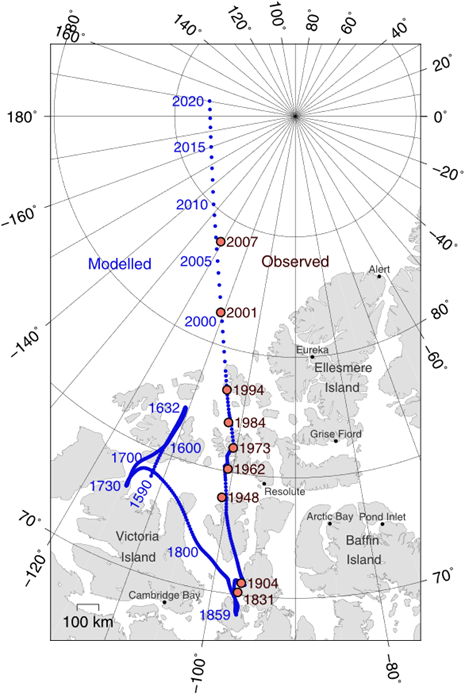
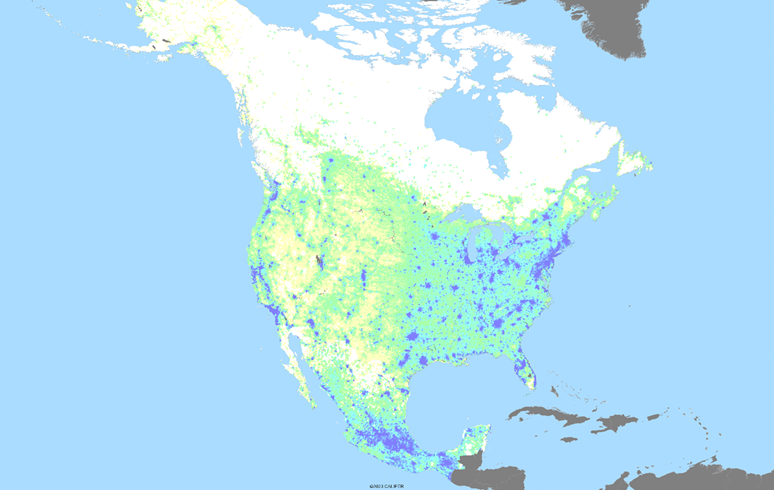
At the same time, North America’s population has been quietly reshaping Santa’s delivery problem. Over the past several decades, the population center has shifted steadily southwest, while Mexico’s population has grown substantially. These changing population dynamics have caused delivery distances to increase and costs to balloon. Adding to the challenge, the continued drift of the magnetic North Pole has caused reindeer to head slightly off course, even with centuries of experience. Thankfully, Santa has modernized. With GPS-equipped reindeer, the North Pole warehouse can remain in place. But Santa realized that keeping a single distribution point was no longer efficient. That is when he approached us to design a new logistics plan.
The assignment was to keep the North Pole warehouse but supplement it with five additional warehouses across North America. As with any site selection project, Santa came with very clear constraints. Warehouses could not be located within 100 miles of a major airport, a rule that dates back to a well-documented 1974 incident near DFW. Locations also could not be in densely populated areas, since the exact locations must not be easily discovered by children. In addition, all sites needed to be in low-crime areas to ensure toy security.
Staffing presented another unique challenge. Contrary to popular belief, elves do not live permanently at the North Pole. During the busy season they are housed in large migrant facilities, but year-round they prefer small towns and rural areas. Elves do not like cities and tend to live in mobile homes, so any warehouse location needed existing mobile home stock to allow them to blend into the local population.
With those constraints defined, we turned to the data. We modeled toy demand using population under age 10 across the United States and Canada, summarized at the H5 hexagon level. This demand surface allowed us to capture where toys actually need to be delivered, not just where people live. We then filtered those hexagons to identify suitable areas that were populated but not dense, located outside airport exclusion zones, had below-average crime risk, and contained existing mobile homes.
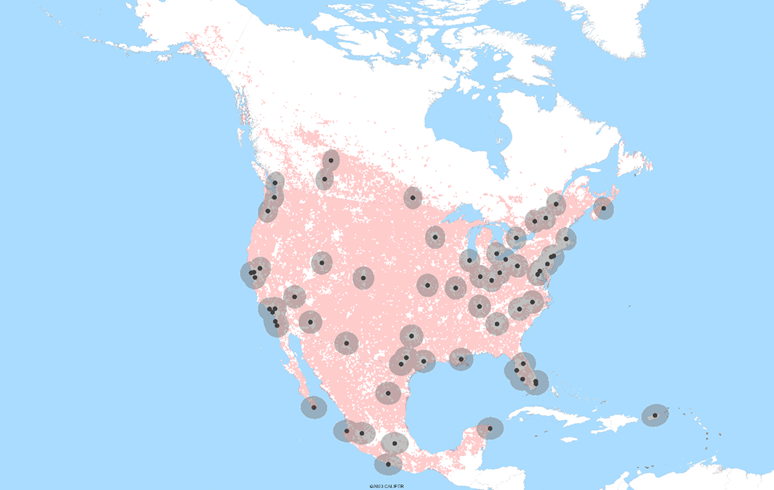
The resulting map shows suitable areas in pink, with grey areas representing airport exclusion zones. From there, we ran multiple scenarios, testing the current North Pole-only solution as well as scenarios with one through five additional warehouses. Because of the NDA we signed with Santa, we cannot share the precise warehouse locations. Instead, the maps use numbered circles to represent proposed sites.
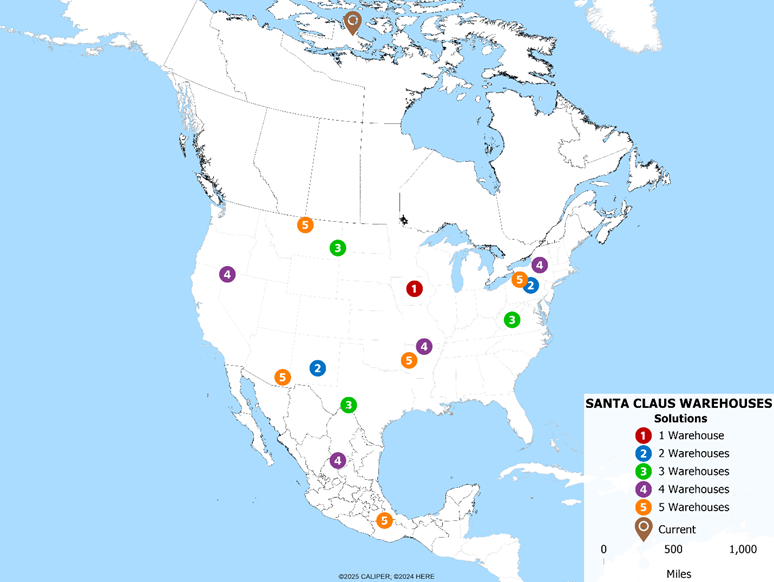
For each scenario, we calculated a “cost of delivery” by multiplying the distance to the nearest warehouse by the number of children served and summing those values across the entire demand surface. We normalized the current North Pole-only solution to a value of 1000. Adding just one warehouse dropped that cost to 133.3. Two warehouses reduced it further to 105.2, while three warehouses brought it down to 87.4. Four and five warehouses lowered the cost to 73.7 and 70.1, respectively.
What stood out was how quickly the benefits tapered off. Once distribution was relocated closer to the population center, the marginal improvement from adding more warehouses became relatively small. At the same time, each additional warehouse increased the risk of discovery. From a risk-reward perspective, Santa may be best served by a one- or two-warehouse solution rather than a sprawling network.
Even for Santa, the lesson is clear. Smart site selection is not about maximizing locations, it is about finding the right ones, using data, demand modeling, and real-world constraints to guide decisions. And whether you are delivering toys on Christmas Eve or goods year-round, the same spatial principles apply.